
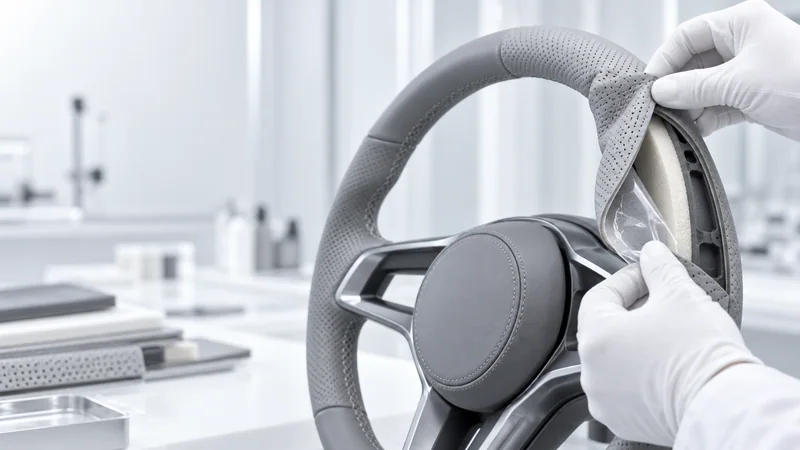
Materials: covering backing and rim surface
Record covering grade, backing treatment and thickness, together with the rim covering or support surface. Distinguish the actual adhesive contact from the internal frame. Identify heating or other functional layers separately so the project defines their compatibility checks.
- Mark coated faces, joints and stitching.
- Retain backing treatment and cleaning records.
Process: curved tension and seam positioning
Specify cutting orientation, wrapping sequence and stitching timing. Record coverage, drying or activation and positioning time. Observe stretch and contact on the inner and outer rim, not only the smooth outer face. Adhesive must not replace the specified seam construction.
- Inspect inner curves, transitions and joints.
- Record wrinkles or lifting after release.
Validation: grip exposure and appearance
Use customer methods for prescribed environments, gripping action and relevant contact media. Record whether separation occurs in the covering, adhesive or rim layer. Wrapping results support only the tested covering combination; they do not qualify steering structures or airbag systems.
- Compare seams with continuous wrapped areas.
- Record discoloration, wrinkles and adhesive transfer.
Project preparation: provide representative curved samples
Supply rim materials, covering pieces, seam drawings, operating sequence and durability requirements. Discuss adhesive candidates with RELANET using curved specimens and current documents. Define the evaluation scope before testing; flat interior lamination results cannot establish rim wrapping performance.
- Include batches, preparation and process limitations.
- Identify functional layers requiring separate assessment.