
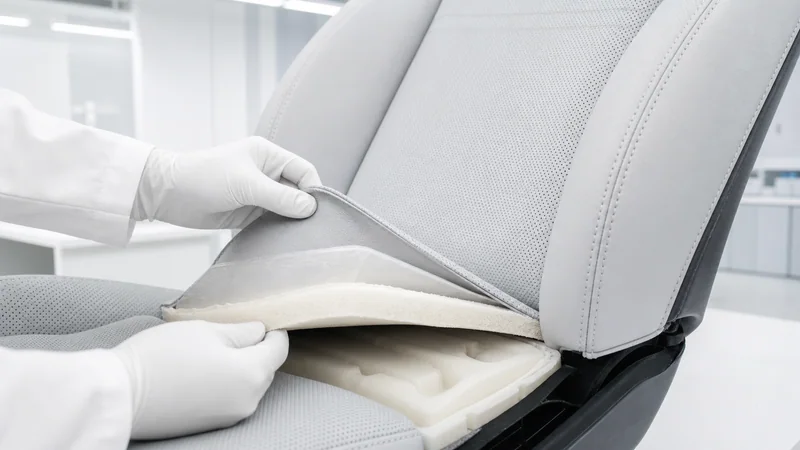
Materials: define the specific bonded areas
Record fabric or leather backing, foam skin, nonwoven and intermediate layers. Mark bonded and uncoated areas. For heating, ventilation or sensing layers, provide the actual stack and project constraints rather than assuming compatibility from a conventional covering lamination result.
- Mark seams, tension points and fasteners.
- Separate continuous lamination from local positioning.
Process: lamination sequence and cushion geometry
Describe application, coating measurement basis, areas and sequence relative to stitching. Record drying, any activation and pressing. Check cushion shape, distribution and excluded areas; fixture pressure alone does not describe the actual condition at each material interface.
- Observe penetration and covering appearance.
- Record contact and condition after release.
Validation: layers and seams after compression
Use customer requirements for repeated compression, environmental conditioning and relevant contact exposure. Record foam damage, separation and covering changes. Seat comfort, functions and safety-related assembly requirements need their respective tests; adhesive peel results alone cannot establish those outcomes.
- Compare compression centers, sides and seams.
- Record test order, failures and appearance.
Project preparation: sample the specified interface
Supply bonding-area drawings, materials and backing samples, production sequence and customer targets. Review current documents with RELANET before agreeing candidate adhesives, specimens and seat-component trials. A successful local bond cannot be extended to approval of the entire seat.
- Include grades, batches and surface preparation.
- Describe functional-layer constraints and project stage.