
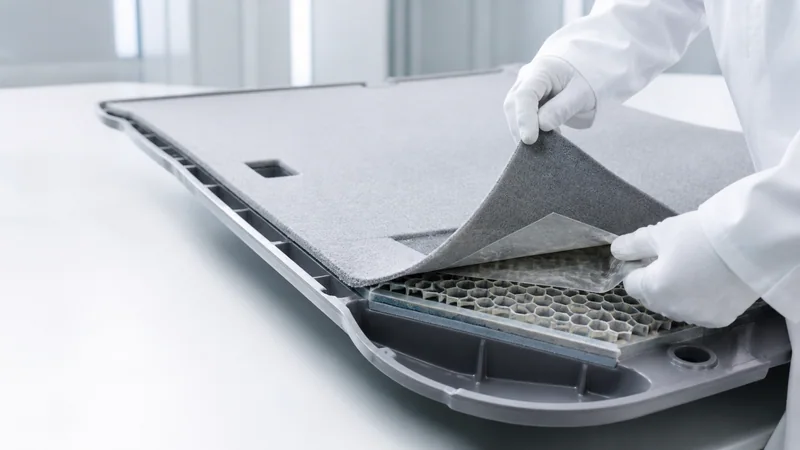
Materials: separate covering and structural core
Record the fabric or felt, core board, underside and edge materials. For honeycomb or another sandwich construction, identify the facing contacted by adhesive. Covering adhesion cannot replace evidence for internal core connections or the structural performance of the complete panel.
- Mark upper, lower and folded surfaces.
- Identify handle openings and local reinforcement.
Process: panel flatness and wrapping sequence
Record coverage, coating quantity, pressing support and timing. Check pressure distribution and missed contact across the panel. For edges, specify the bend geometry, wrapping sequence and holding method, then observe the panel and returns after fixture release.
- Inspect adhesive around openings and edges.
- Separate flat pressing from edge fixation.
Validation: interfaces after bending and loading
Apply the customer's loading, bending and conditioning requirements, recording lifting, separation and surface appearance. Distinguish adhesive failure, core damage and covering tears. A flat peel value alone cannot establish the load-bearing acceptance of the spare wheel cover assembly.
- Record load positions and panel supports.
- Compare faces, returns and opening edges.
Project preparation: represent installed support conditions
Provide the construction drawing, core and covering samples, installed supports and specified tests. RELANET can discuss candidates and sample arrangements using these inputs. Changes to board, backing or wrapping require reviewing which bonding and assembly requirements need revalidation.
- Include grades, dimensions and manufacturing sequence.
- Identify development stage and failure locations.