
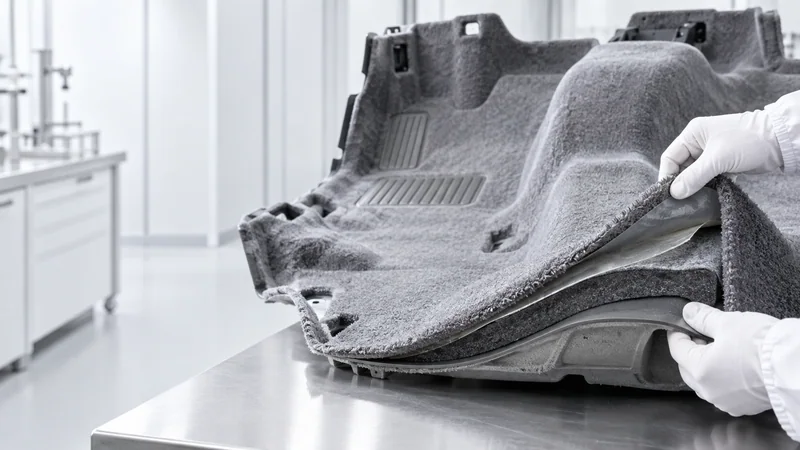
Materials: identify each backing interface
Record backing coatings, foam, felt and other underlay grades and thicknesses. Establish whether the adhesive contacts a coating, fibers or an existing film. For porous layers, examine distribution through the thickness rather than selecting from the word carpet alone.
- Mark layer orientation and coated faces.
- Distinguish full lamination from local attachment.
Process: coverage and contact during forming
Specify spraying or rolling, the coating measurement basis and assembly sequence. Check coverage around footwells, raised areas and returns. Record drying, any activation and pressing separately, including relevant material conditions rather than equipment settings alone.
- Inspect penetration and face appearance.
- Record forming sequence and transfer time.
Validation: interfaces after compression
Compare initial, cured and conditioned bonds under the project requirements. Record separation after specified compression or local bending and identify the failed layer. Adhesive results alone do not establish carpet assembly acoustics, odor or emissions; those require the applicable assembly tests.
- Record peel method and substrate tearing.
- Check conditioned appearance against customer requirements.
Project preparation: provide actual backing samples
Send individual materials, backing details, formed-part images or a layer drawing, equipment and cycle requirements. Discuss candidates with RELANET after agreeing representative specimens and criteria. Request current documents and samples; acceptance from another component cannot establish this carpet's suitability.
- Include grades, batches and intended tests.
- Describe separation, penetration or contact problems.