
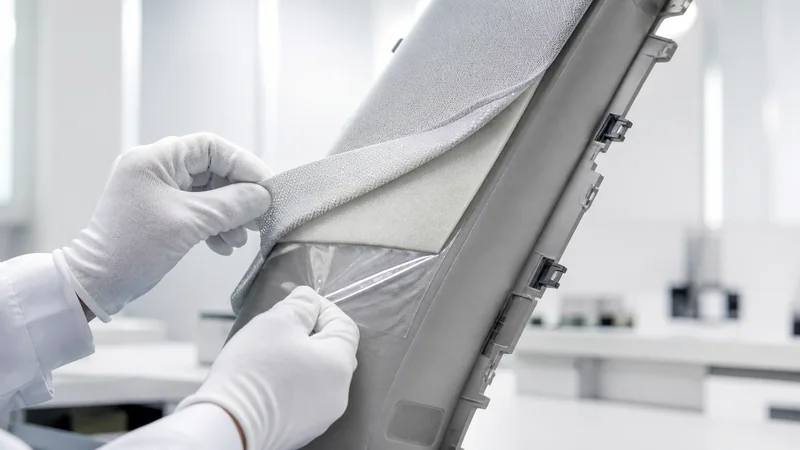
Materials: backing and slender carrier surfaces
Record fabric backing, foam or other intermediate layers and the carrier grade. Mark coated surfaces, edges and openings. Identify backing coatings and carrier treatments separately; the generic trim material category cannot establish adhesion at every interface in the assembly.
- Mark narrow faces, tight curves and returns.
- Identify clips and adjacent installation areas.
Process: narrow-area coverage and support
Describe application, coverage path, drying or activation and pressing sequence. Record support positions and release method for the slender part. Inspect inner curves, ends and returns instead of relying only on observations from the relatively flat central area.
- Record positioning, transfer and pressing times.
- Check returns for interference around clips.
Validation: local geometry and installed interfaces
Record wrinkles, lifted edges and separation after agreed curing, conditioning and installation. Combine flat peel tests with representative curved specimens. If trim intersects a safety-related deployment area, the customer must separately define and verify the complete assembly requirements.
- Compare ends, inner curves and returns.
- Distinguish substrate damage, separation and distortion.
Project preparation: show trim and installation positions
Provide layers, grades, representative trim, installation drawings and customer test targets, including equipment limits for application and pressing. RELANET can discuss candidates and document needs. Changing the backing or carrier grade requires reviewing the interfaces that need renewed evaluation.
- Include preparation, cycle and sample batches.
- Identify defects and their first appearance.