
1. Company introduction: RELANET
China's automotive industry is moving toward electric vehicles, lighter construction and greener manufacturing. Automakers and interior suppliers need better cabin environmental quality, durable interiors and lower production costs. The adhesive used for wrapping and lamination affects cabin air quality, service life and line efficiency.
RELANET has worked for many years on water-based polymer bonding materials for automotive interiors. It develops, makes and sells water-based polyurethane dispersions (PUDs), matching hardeners and application solutions. Its R&D focuses on molecular modification for this market.
RELANET works in South China's automotive supply region. Its work covers formulation development, substrate samples, process matching and quality validation. Use the customer-specified NES M0160 for odor. Confirm VOC, cabin air quality, durability and REACH-related requirements separately. Available records should support claims about laboratory capabilities, equipment and credentials. Tests on material samples do not prove approval of a whole vehicle or every product grade.
RELANET's R&D team includes engineers in polymer materials, automotive processes and interior applications. The team modifies molecular chains for specific needs. It does not rely on simply blending general-purpose PUDs.
The work targets five common problems: cold-wrapping cracks, heat-related debonding, poor substrate compatibility, excess residual VOC and narrow activation windows on automated lines. The polyester/polycarbonate-modified PUD system now includes dozens of products for manual wrapping, vacuum forming and fully automated wrapping. They serve combustion-engine vehicles, new-energy passenger vehicles, commercial vehicles and recreational vehicles.
RELANET combines product supply, process support and custom development. Before a sale, it provides substrate-bonding samples and line evaluation. During setup, engineers tune spraying, roller coating and knife coating at the customer's site. Afterward, the team supports high/low-temperature aging, humid-heat cycling and third-party VOC testing.
Custom samples for new vehicle programs can be prepared within seven working days. These can address low-surface-energy PP, rigid TPO and ultrathin microfiber, helping shorten component validation.
The manuscript reports supply to dozens of Tier 1 interior companies. Applications include instrument panels, door trim, seats, headliners, armrests and luggage-compartment boards. Stable performance, low odor and use across different processes support the shift to water-based adhesives.
RELANET is developing bio-based, lower-carbon PUD and ammonia-free, low-odor modified systems. Its R&D focuses on lower emissions, long-term durability and efficient production. The aim is to replace high-VOC solvent-borne adhesive in automotive interiors and support greener manufacturing.
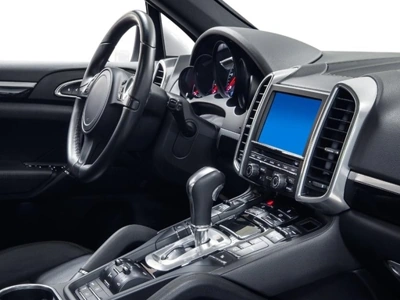
RELANET PUD applications across the complete vehicle cabin
2. RELANET PUD products for automotive interior bonding
A water-based PUD is a polyurethane dispersion used in formulation. Select the finished adhesive, matching hardener and process by confirmed grade and latest TDS. Check R-5670 and R-5610 uses and parameters separately. Do not rely on unconfirmed historical model names. Evaluate substrates and interfaces for PU leather, PVC, TPO, leather, microfiber, PP/ABS, EVA and nonwovens. One formula does not automatically suit every material or remove the need for pretreatment.
(1) Basic physical and chemical properties
The basic parameters of the two products were measured under standardized laboratory conditions and are shown in the following source figure:
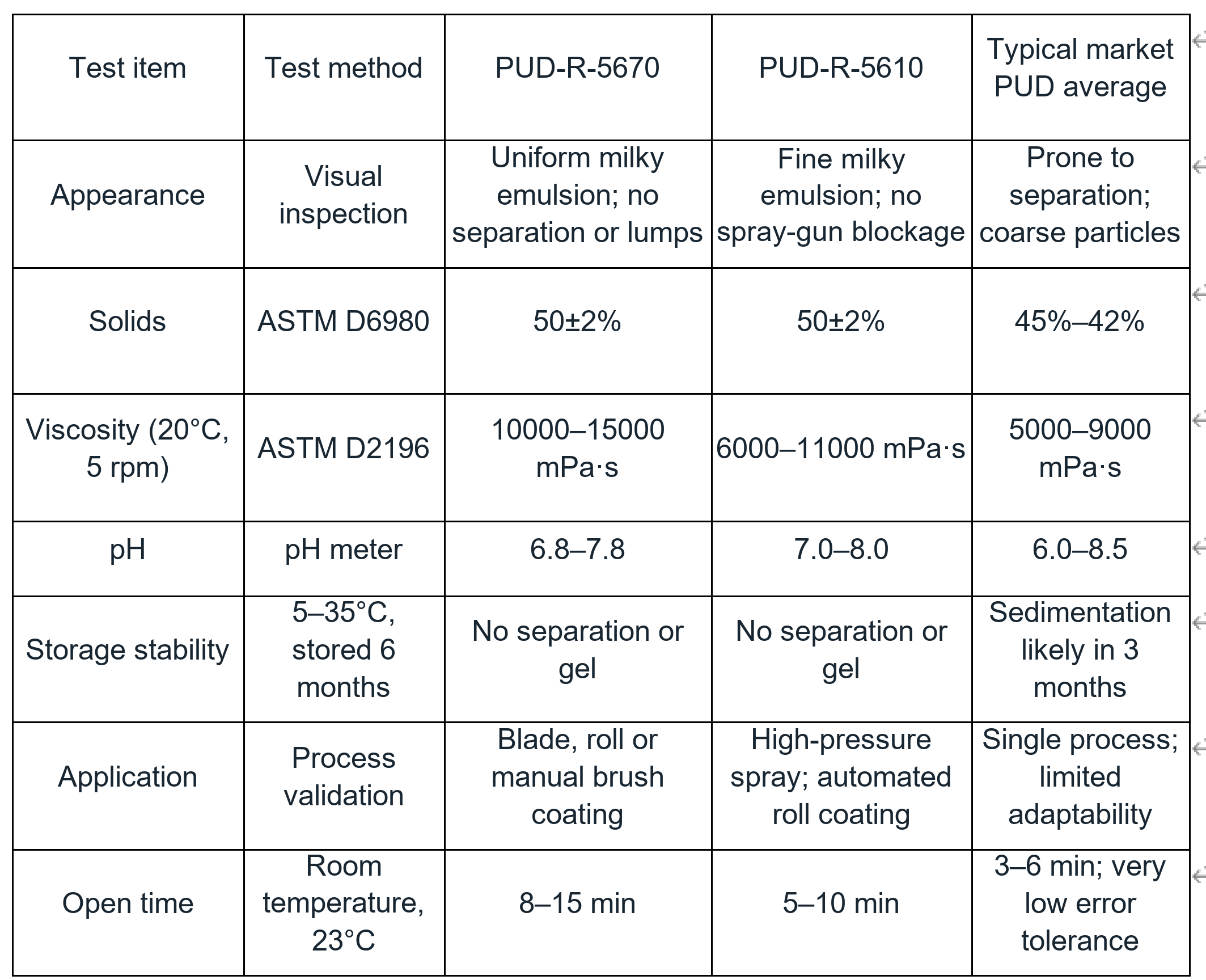
The source describes high solids as a main advantage. It reports solids more than five percentage points above an ordinary market PUD. The stated comparison uses 20%-30% less adhesive for the same bonded area, reducing cost per interior set.
Viscosity is matched to the process. The manual grade is thick enough to resist sagging. The line grade runs through a 2.0 mm spray setup for extended periods without blockage. An 8-15 minute open time lets operators move leather on complex surfaces and corners. This reduces bubbles, wrinkles and rework.
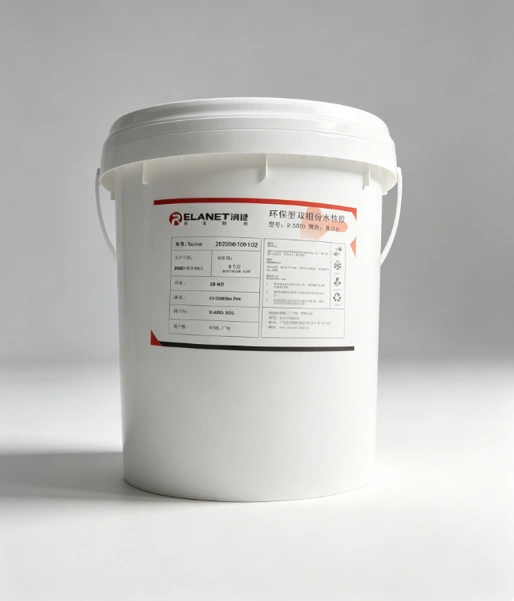
Original product-package photograph. The Chinese brand and physical label are retained as photographed; consult the current label and safety data sheet.
RELANET PUD finished-product packaging
(2) Mechanical bonding performance
Bond strength and film flexibility help keep interior parts bonded and prevent long-term edge lift. The source manuscript reports that its two cured PUD products exceeded the cited industry baseline in the tests below.
- Elongation at break and tensile toughness
The source reports ASTM D412 elongation results at a 10°C workshop temperature: 600%-1,000% for RJ810 and 750%-1,100% for RJ830. At 23°C, elongation exceeded 1,200%. Tensile strength was 28-32 MPa.
The source describes 300%-500% elongation for conventional water-based PUDs at low temperature. This raises the risk of folded-edge cracks and corner lift during winter wrapping. RELANET's modified chain structure helps the film follow the skin. It can deform with vibration and thermal expansion and contraction.
- 180° peel strength on multiple substrates
Peel force measured after 24 hours of curing:
- Microfiber leather + ABS carrier: ≥1,150 N/m.
- TPO skin + modified PP board: ≥980 N/m.
- Natural leather + EVA foam: ≥1,300 N/m.
- Flexible PVC skin + wood-plastic interior board: ≥1,050 N/m.
Skin failure in a peel test shows where that specimen failed under those conditions. It does not prove equal strength on all substrates or PUD bonding of PP and TPO without pretreatment. Check cleaning, primer and activation needs for the actual materials and adhesive. Do not apply the confirmed PP process for R-7206 and R-7110 to every PUD grade.
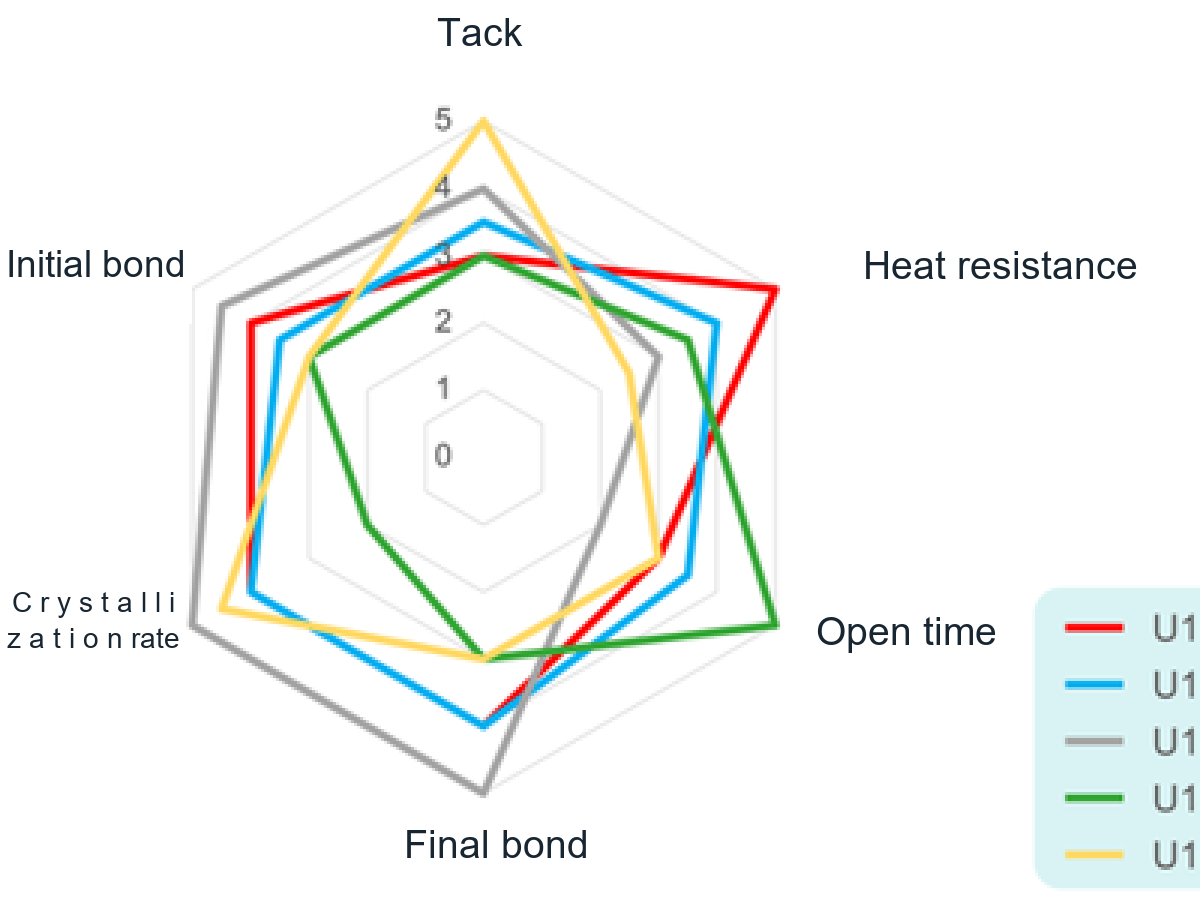
PUD bonding-performance radar comparison
- Creep resistance and vacuum-forming stability
In vacuum-forming tests at -0.09 to -0.1 MPa, the film kept stretching without slipping or separating. The referenced line reached its initial-tack plateau after 40-60 seconds of activation at 120-130°C. The activation window was 110-140°C. The source reports a 15%-25% increase in line efficiency. End-of-line bonding defects were below 0.3%, compared with a stated industry average of 2%.
(3) Weathering and durability: vehicle-level environmental simulation
Automotive interiors may face -40°C winters, 90°C summer exposure, humid rainy seasons and long-term vibration. Adhesive durability affects a component's three-to-eight-year service life. The manuscript reports the cyclic-aging results below.
- High- and low-temperature cycling
The test used 50 cycles, each with four hours at -40°C and four hours at 90°C. Peel-strength retention was ≥88%. The film showed no whitening, embrittlement, shrinkage or debonding. The source reports that ordinary market PUDs lost more than 40% of bond strength after 30 cycles. They also showed extensive corner lift.
- Humid-heat hydrolysis resistance
After 1,000 hours at 60°C and 95% RH, the film showed no hydrolysis or whitening. It retained 85% of peel strength. Polycarbonate-modified chains improve hydrolysis resistance in hot, humid and coastal service. They are intended to reduce moisture-related blistering and detachment.
- Heat exposure and yellowing resistance
The original material reports observations after 500 hours at 85°C. Check the adhesive grade, bond-line thickness, specimen and original results before use. An aliphatic structure can reduce yellowing. Light leather and white TPO still need color-change and migration tests. The evidence does not establish permanent freedom from yellowing or skin contamination.
- Resistance to oils and cleaners
The source reports 72-hour contact with hand cream, leather-care product and interior cleaner. It found no significant loss of bond strength or swelling of the adhesive layer. The test addresses a common after-sales failure linked to interior cleaning.
(4) Separate odor, VOC and regulatory assessment
As new-energy vehicle manufacturers tighten odor and VOC controls, RELANET addresses environmental performance from the raw-material stage:
- A VOC result must state its specimen, method, unit and acceptance criterion. The original values of below 8 mg/L and 50 mg/L lack a directly comparable test basis. They must not be presented as a GB/T 27630 adhesive limit or compliance result. Agree on the component VOC test and target for the project.
- Use the customer-specified NES M0160 revision, sample and conditions for odor. Any stated grade needs a matching report. Odor testing does not replace occupational-exposure, ventilation or fire-protection assessment. It cannot justify removing production safeguards.
- Test emissions from both the cured adhesive and complete laminate for the project. Check targets such as acetaldehyde, toluene and xylene separately. Component results do not prove whole-vehicle air-quality compliance. They also do not show that every cured grade is free of emissions.
- For the stated product, the source describes the water-based system as outside hazardous-chemical classification. Compared with solvent-borne adhesive, it reports lower storage, transport and hazardous-waste costs and less safety-management pressure.

Finished appearance of an environmentally oriented interior application
(5) Process compatibility advantages
The original material gives these starting points for process planning: manual open time of 8–15 minutes and line open time of 5–10 minutes. Tack-free drying takes 10–25 minutes at room temperature; oven drying takes 3–8 minutes at 80°C. Confirm each window for the grade, coat weight, humidity and equipment.
Different coating and forming processes may need different formulas. Check cleaning, primer or activation separately for PUD bonding of PP and TPO. The confirmed PP capability of R-7206 and R-7110 is not a PUD property. Use controlled line records to calculate changes in rework, material use and cycle time. Do not promise fixed savings.
(6) Main application scenarios
For instrument and door-panel wrapping, check the skin, backing, carrier and folded-edge loads. Seats and armrests also face repeated compression and abrasion. Headliners and luggage boards need control of absorption, warpage and humid-heat durability.
Enclosed recreational-vehicle cabins still need odor and VOC assessment. Choose PUD through material, process, appearance and durability tests. One formula does not cover every part by default. Water-based chemistry alone does not prove vehicle compliance or fixed savings.
Separate odor, VOC and durability validation
NES M0160 covers odor testing of automotive interior parts. It does not replace VOC, cabin air-quality, durability or regulatory assessment. Confirm the revision, sample, conditions and project targets. Naming a standard does not prove a pass.
- Use the customer-specified NES M0160 revision and odor test conditions. Any stated grade requires a valid report for the corresponding sample.
- Confirm VOC methods and targets separately. Nissan projects may involve NES M0402 and NES M0403. GB/T 27630 covers passenger-vehicle cabin air quality; it is not a single adhesive VOC limit. Check REACH, ELV and durability requirements separately.
Sources and validation basis Nissan · NES M0160 / NES M0402 / NES M0403