
RELANET · Updated
Reported production programs
Dongfeng Nissan N7, N6 and NX7; GAC Toyota Bozhi 3X; BYD Denza Z9GT
According to RELANET project records, R-5670 with R-60C has been used in the listed vehicle programs. Check the actual part, project stage and supply batches against original records; vehicle names do not imply manufacturer endorsement. The peel data on this page come from a separate test and are not acceptance results for these vehicles.
Separate anonymized development case, not linked to these vehicle programs: RELANET’s Eight Project Development Steps: Resolving Door-Trim Blistering Before Production →
Confirm the adhesive and curing-agent pairing
Identify R-5670 and R-60C by their full product names and document versions when requesting samples. Confirm the approved pairing, mixing basis, preparation method, storage and handling instructions before use. Do not replace R-60C with another component based only on a similar description.
Two-component describes the specified mixing arrangement. It does not establish suitability for every fabric, foam or plastic grade. The complete system must be evaluated against the intended interface and process.
R-5670 + R-60C company peel-test results
According to company test information published on 20 September 2026, R-5670 with R-60C produced the following typical results when bonding a PVC + knitted-fabric composite to flame-treated PP.
| Item | Test conditions and result |
|---|---|
| Material combination | PVC + knitted-fabric composite / flame-treated PP |
| Adhesive system | R-5670 + R-60C |
| Peel method | Specimen width: 25 mm; 180° reverse peel; speed: 200 mm/min |
| Peel force 1 minute after bonding | Average 25 N/25 mm; timing starts when bonding is completed Test conditions |
| Peel force after 7 days of curing | Approximately 60 N/25 mm; measurement temperature: 23°C ± 5°C Test conditions |
These results apply to the stated material combination and test process and support preliminary project selection. They are not performance guarantees for other substrates, processes or a specific project. Project acceptance requires the corresponding original test reports, replicate-specimen results and customer requirements.
This section specifically cites the test information published on 20 September 2026. The appearance of 25 N in both an older webpage and this test does not establish that they refer to the same test, nor does it verify the historical record.
Mixing ratio and application parameters
The following references apply to the R-5670 base component used with R-60C. The TDS carries the internal version 2025-06; the company confirmed on 2026-10-18 that it remains valid. Use the ratio and process confirmed for the specific project.
| Item | Reference value and scope |
|---|---|
| Adhesive system | R-5670 + R-60C (blue hardener) |
| Mixing ratio | R-5670 : R-60C = 100:(5–8) by mass. Weigh to the project-confirmed ratio; do not adjust it arbitrarily on the production line. |
| Base-component solids | Approximately 47%–50%, as typical information in this TDS version; not a measured value for every batch or a guaranteed limit. |
| Use after mixing | Store and use the mixed system under the reference condition of 23°C ± 5°C. Use within 8 hours, timed from the start of mixing. |
Sources: the current valid R-5670 TDS (internal version 2025-06) states base-component solids, the R-60-series ratio range and use within 8 hours. Compatibility with R-60C, the mass-ratio basis and the 23°C ± 5°C reference condition after mixing were confirmed by the company on 2026-10-18. The mass basis and temperature condition are not stated verbatim in the PDF.
The 8 hours is the use period after mixing, not the final cure time or the storage life of unopened product. Follow the TDS for unopened storage. Confirm other temperatures, batch sizes and site conditions separately. Request the TDS and SDS for both components with samples.
The peel-test article published on 2026-09-20 does not state the ratio used in that test. Do not assign these application references to its mixing ratio, one-minute test temperature or seven-day curing environment.
Assess peel results, heat resistance and humidity resistance separately
The one-minute result describes initial bond strength in an early peel test. The seven-day result describes peel performance at the stated later checkpoint; it is not proof that every process has reached a final-strength plateau. These results inform early handling and later bond assessment, while heat, humidity and customer acceptance still require separate testing on the actual part.
The heat- and humidity-related TDS results cited in the test article concern an ABS + PVC material combination. The curing agent used for that combination still requires confirmation from original records. Keep those data separate from the company peel results for PVC + knitted fabric / flame-treated PP with R-60C; they do not establish durability performance for that tested combination.
View the scope of the ABS + PVC TDS data and heat-resistance evaluation
Use application pages to frame candidate trials
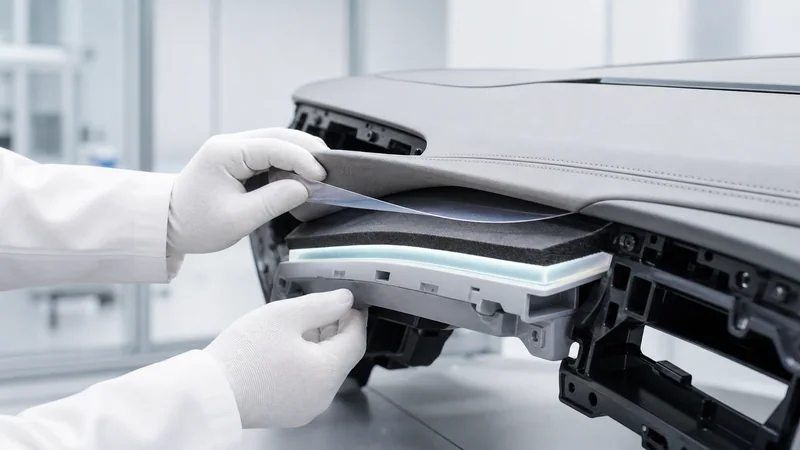
Headliner development needs separate targets for early holding, wet coating sag, assembly creep, humidity aging and final strength. Door trim adds edge wrapping and springback. Instrument panels require representative geometry and observations after tool release.
These are candidate evaluation routes, not approved application lists. For PP, ABS, fabric and foam, record the grade, actual bonding surface and preparation. Qualify the combination on the intended materials and process before extending a result to another part.
Request current documents and a defined sample evaluation
Request the current issued TDS and SDS for R-5670 and R-60C, and check the original test reports and replicate-specimen records supporting the published peel results against your project requirements. Send your layer stack, material grades, surface preparation, adhesive application and bonding cycle, acceptance requirements and project timing.
Agree on representative specimens and the observations needed before arranging a trial. Keep document versions, material batches and processing conditions with the results so the technical discussion can distinguish supplied instructions, observed performance and customer acceptance.
When reviewing a reported final bond strength, check the elapsed time, drying or curing history, conditioning, measurement temperature and failure location in the supporting record. The headliner test-record guide illustrates how to separate tack, early handling and later strength without transferring this product test to a headliner assembly.
Questions and answers
How do 25 N/25 mm at one minute and approximately 60 N/25 mm after seven days differ?
The two results describe early bonding and peel performance after seven days of curing, based on company test information published on 20 September 2026. The early result helps assess holding and transfer to the next operation; the seven-day result helps assess cured bond performance. Neither directly replaces heat, humidity or customer acceptance testing on the actual part. View conditions and source
Which stage does 23°C ± 5°C apply to?
In the peel test published on 2026-09-20, 23°C ± 5°C is specified only as the measurement temperature for the seven-day result. It is not a confirmed one-minute test temperature and does not establish the curing environment throughout the seven days. The reference condition of 23°C ± 5°C after mixing comes from a separate company confirmation and has a different meaning and source. View conditions and source
Which documents define the ratio, pot life and solids content?
Use the current valid R-5670 TDS (internal version 2025-06) and the company confirmation dated 2026-10-18: R-5670 : R-60C = 100:(5–8) by mass; base-component solids approximately 47%–50%; use the mixed system within 8 hours from the start of mixing under the reference condition of 23°C ± 5°C. Follow the project-confirmed process and request the TDS and SDS for both components. The peel article does not state its test ratio. View conditions and source