
RELANET · Updated
Define the manufacturing stack and each interface
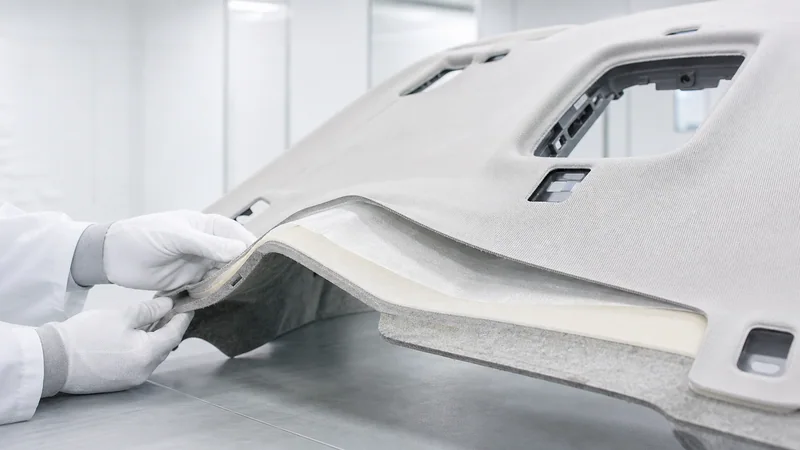
Identify the face fabric and its backing, foam grade, supporting layer and the interface under evaluation. Record whether the adhesive is applied to one or both surfaces and whether bonding is flat or shaped. Include edge areas and local geometry when choosing representative specimens.
Define the Bonding Targets for Your Headliner Project
A test target is meaningful only when the substrates, process, conditioning and acceptance criteria are specified. The five requirements below are development targets, not measured results or claims of approval. No traceable original R-5670 headliner project report has been supplied for this page.
| Project target | What to evaluate | Conditions to record | Evidence status |
|---|---|---|---|
| Initial tack and early holding | Immediate grab and handling hold, separately from final strength | Stack, bonding or activation, pressure, elapsed time and method | Existing website early-peel information is not a headliner report |
| Wet coating sag resistance | Movement of the wet adhesive before bonding | Coat weight, viscosity method, orientation, temperature and observation time | Project target; no direct R-5670 result supplied |
| Heat resistance and assembly creep | Bond retention, displacement and failure under heat and load | Temperature, duration, load, orientation, stack and failure criteria | Historical heat claims need original-report checks; no headliner approval established |
| Humidity aging and hydrolysis resistance | Retention after conditioning, with the test rationale stated | Humidity or water exposure, temperature, duration, cure and before/after results | Historical claims require method and applicability verification |
| Final bond strength | Cured and aged strength together with failure mode | Cure, conditioning, peel geometry, speed, width and substrate failure | One-minute early peel cannot replace final-strength testing |
Separate wet coating sag from assembly sag
Wet coating sag concerns movement of the liquid layer before bonding. Assembly sag or creep concerns movement of the bonded part under defined exposure and load. They occur at different stages and need separate methods, observations and criteria.
A coating that stays in place does not establish heat resistance of the finished assembly. Likewise, an early peel value does not describe displacement over time. Keep these records separate in the trial report.
Evaluate R-5670 with R-60C as a candidate
Request the latest issued instructions for the R-5670/R-60C system before preparing samples. The existing product page contains typical mixing, early-peel and pot-life information whose current validity and full conditions require confirmation.
Do not transfer sag, hydrolysis or headliner claims from other product grades mentioned in older technical articles. Evidence should identify this system, this material stack and the relevant process.
Plan a sample evaluation with clear decisions
Send grades, layer structure, surface preparation, coating method, coat weight, drying or activation, cycle requirements and customer specifications. Define observations immediately after bonding and after the required curing and aging stages.
Record failure location and assembly appearance alongside strength and displacement. Leave target values and pass/fail status unassigned until the project criteria are agreed and actual results are available.
Questions and answers
Can R-5670 meet our headliner specification?
It can be considered with R-60C for evaluation. Confirmation requires current technical data and tests on your stack under the specified process and durability conditions.
How are tack, early holding and final strength different?
Tack concerns immediate grab, early holding concerns handling before full strength develops, and final strength follows specified curing and conditioning. State a method for each.
Are the five KPI rows measured product results?
No. They organize project targets and the conditions needed to test them. No project values or approval status are assigned here.