
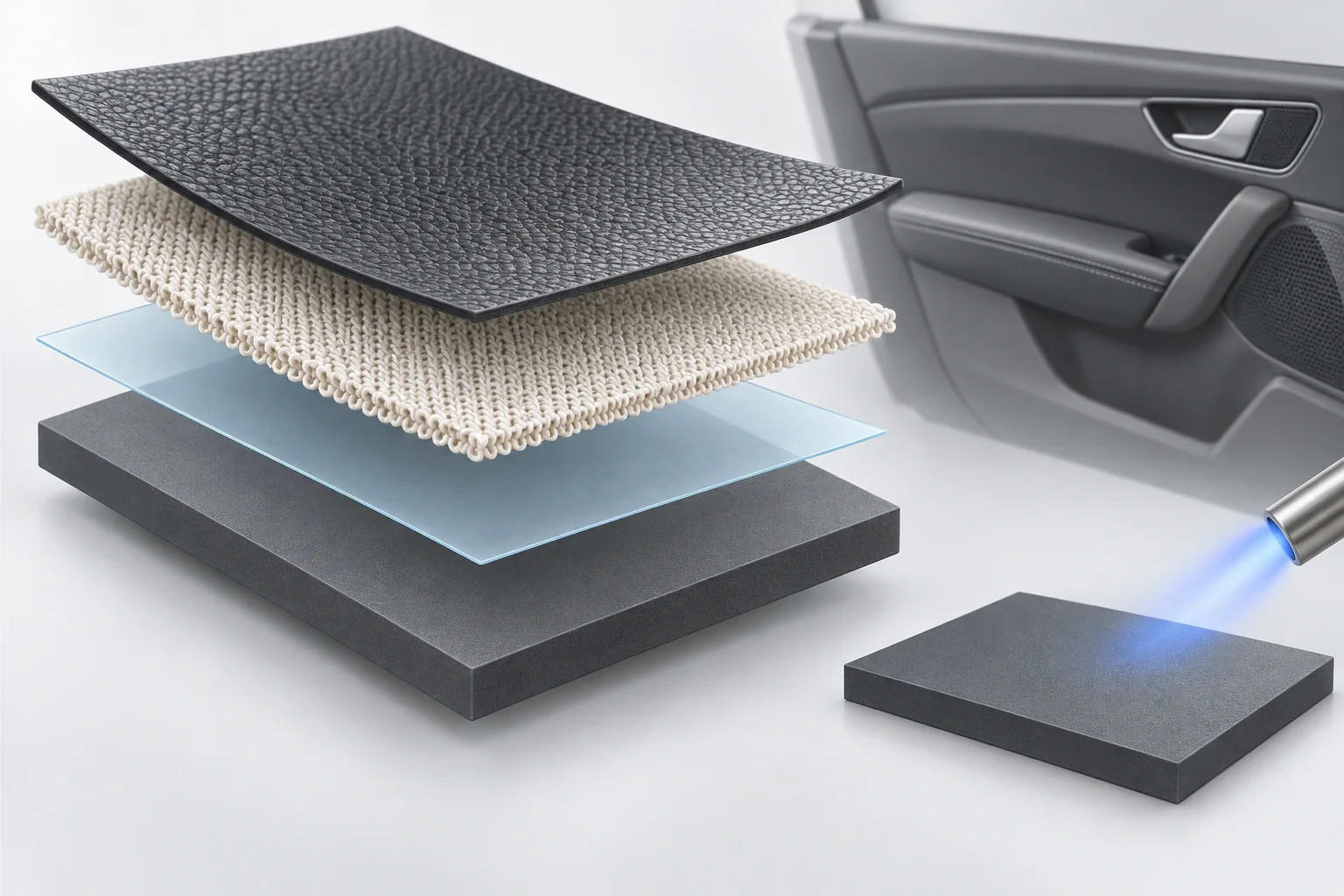
In company testing of PVC with knitted backing bonded to flame-treated PP, average peel force was 25 N/25 mm at 1 minute after bonding and approximately 60 N/25 mm after 7 days of conditioning. Both measurements used 180° peel at 200 mm/min; final strength was measured at 23°C ±5°C.[1]
High initial strength supports demoulding and handling decisions
Fabric springback and handling loads act on wrapped edges and curved parts after demoulding. The average 1-minute result of 25 N/25 mm indicates early peel resistance in this combination and provides a basis for assessing holding and transfer time. Actual demoulding time still depends on geometry, edge tension and pressing conditions.
Start the 1-minute clock when bonding is completed. Stringing in a hand-pull check cannot replace a peel measurement at a defined speed. R-5670 provides adhesion and R-60C participates in crosslinking; effective adhesive coverage on the knit, PP treatment, drying and activation all need control.[2][3]
Check final strength and failure location after seven days
Approximately 60 N/25 mm after 7 days is a typical result for this assembly under the stated process. Record whether separation occurs at the PP/adhesive interface, within the adhesive, or in the knitted backing or skin. Failure location helps identify whether the interface or the process needs adjustment.
Peel force at two test stages
| Company test | Conditions and result |
|---|---|
| Materials and adhesive | PVC with knitted backing / flame-treated PP; R-5670 + R-60C |
| Peel method | 25 mm specimen width; 180° peel; 200 mm/min |
| Initial strength | 1 minute after bonding: average 25 N/25 mm |
| Final strength | After 7 days: approximately 60 N/25 mm; measured at 23°C ±5°C |
These are typical company test results. Acceptance requires original curves, replicate specimens and the customer's limits.
Assess both peel strength and movement under heat and load
Room-temperature peel and hot holding performance address different risks. Peel after heat ageing assesses material changes; creep under sustained heat and load checks edge opening and skin movement.
The following values are reported in an existing R-5670 TDS for ABS + PVC, a different substrate combination from the PP results above. Confirm the curing-agent grade against the original records. These datasets must not be combined into a complete validation of one system.[2]
| TDS evaluation | Conditions | Reported result |
|---|---|---|
| Peel after heat ageing | 90°C × 7 days | ≥45 N/25 mm; substrate failure |
| Conditioned heat creep | 80°C × 100 g × 24 h | No displacement |
| Peel after humid ageing | 50°C × 95% RH × 7 days | ≥45 N/25 mm; substrate failure |
TDS peel conditions: 180°, 200 mm/min. The 90°C ageing exposure is not a peel result at 90°C or a continuous-service temperature guarantee.
Early heat exposure needs separate assessment. The same TDS records cohesive adhesive failure in an initial creep test started within 10 minutes of bonding, sequentially at 40°C / 200 g / 30 min and 80°C / 200 g / 30 min. No displacement for conditioned specimens does not establish hot holding performance immediately after bonding.[2]
Validate water resistance and hydrolysis resistance separately
Water-based describes the dispersion medium; resistance after curing must be tested. Water contact or immersion testing examines peel loss, blistering and interfacial separation. Hydrolysis assessment concerns irreversible deterioration under sustained humid heat. One immersion result does not cover long-term humidity risks, and strength loss after humid ageing alone does not prove hydrolysis.
For PVC-knit/flame-treated PP, use customer-defined immersion and humid-ageing conditions and agree whether testing is wet or after recovery. Record strength, retention and failure location. R-60C ratio, mixing, usable time and conditioning influence the result; adding more curing agent cannot replace validation.[3]
Turn laboratory results into a project selection plan
Identify the component, OEM or Tier 1 specification and acceptance limits. The 180° peel configuration follows the flexible-to-rigid assessment direction described by ISO 8510-2; full method conformity requires checking preparation, conditioning, measurement and data processing.[4]
ISO 9142 can guide ageing-condition selection and ISO 10365 can support consistent failure descriptions.[5][6] Test methods, product data and project approval serve different purposes. The 25 N and approximately 60 N results alone do not establish automotive project approval.
- Materials: record PVC, knit and PP grades and batches, including the interval from flame treatment to coating.
- Process: record adhesive and curing-agent batches, ratio, usable time, coat weight, drying, activation, pressing and conditioning.
- Retesting: agree 25 mm width, 180°, 200 mm/min and the 1-minute and 7-day checkpoints.
- Durability: define heat ageing, loaded creep, immersion, humid ageing and recovery; retain replicate results and original curves.
- Components: check actual wrapped edges and corners for continuous adhesive coverage and adequate pressing contact.
Sources and test-method references
[1] RELANET company test information and confirmed conditions, 2026-09-20. Formal acceptance is subject to the corresponding original test report.
[2] R-5670 TDS: filename version v26.7, document version 2025-06, pages 2–3. Values reproduced from the supplied technical article.
[3] R-60C curing-agent data sheet: filename version v25.6, document version 2022-03. Follow the current approved system process.
[4] ISO 8510-2:2006
[5] ISO 9142:2003
[6] ISO 10365:2022