

An in-depth look at automotive interior bonding technology
From single-part ROI to a platform-level manufacturing architecture
Why the real dividing line is not adhesive price, but design authority, the data thread and platform assets.
For process, equipment, quality, purchasing, finance and platform-engineering teams.
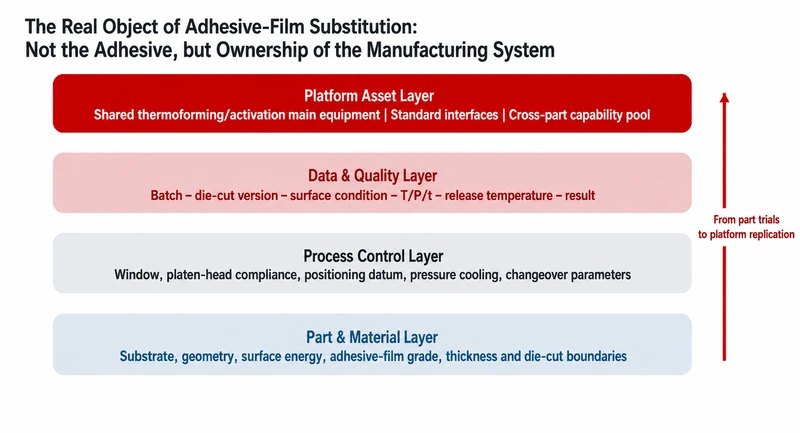
Original infographic. This second article focuses on platform manufacturing architecture rather than repeating the first article’s per-vehicle price and hidden-cost reversal analysis.
Start with the conclusion: one part type buys equipment; multiple part types build a platform
If one part, one tool and one primary machine are compared with a mature spray line, adhesive film can easily lose an investment review. The reason is not that the material lacks value, but that too few projects share the asset. In the current simulation, one part-specific die is approximately RMB 1.2 million based on the user’s experience. Adding RMB 2 million of shared primary equipment brings initial film investment to about RMB 3.2 million. Compared with an RMB 800,000 spray-line retrofit, incremental investment is approximately RMB 2.4 million. Although first-year operating savings are projected at RMB 544,800, five-year NPV is about -RMB 128,000 and IRR about 6.0%, below the 8% discount rate.
The second review should therefore stop asking only “How much does film cost per square metre?” It should ask five harder and more valuable questions: Who owns the process definition? Which assets can be shared? Which changes trigger reinvestment? How can process evidence be replicated across vehicle programs? Where do cost and risk ultimately sit?
| Review question | Spray-process mindset | Platform-film mindset |
|---|---|---|
| Investment object | One station/one line | Shared equipment + modular toolkits + data system |
| Process asset | Maintained through shop-floor experience | Replicable windows, recipes, versions and traceability structure |
| Cost boundary | Material, labour and spray-booth expense | Lifecycle cash flow + change tax + risk loss |
| Project boundary | Each vehicle program calculated independently | Platform portfolio investment and capacity allocation |
| Release method | Pass one test | Closed material-process-equipment-data evidence loop |
Table 1 | The second article’s analytical perspective: from material replacement to platform-level manufacturing capability.
1. The most commonly missed issue is not a cost item, but cost ownership
Adhesive film moves part of manufacturing complexity upstream from the spray shop into coating, die-cutting and incoming quality. Cost does not disappear; it moves from shop-floor operating expense into supplier capability, dedicated tooling, inventory and version management. If commercial terms are still written like a conventional material purchase, grey areas emerge after launch: Who funds the primary equipment? Who owns the die? Who pays for rework after an engineering change? Who receives residual value after end of production? Does the supplier’s pre-coated-part price already include equipment amortization?
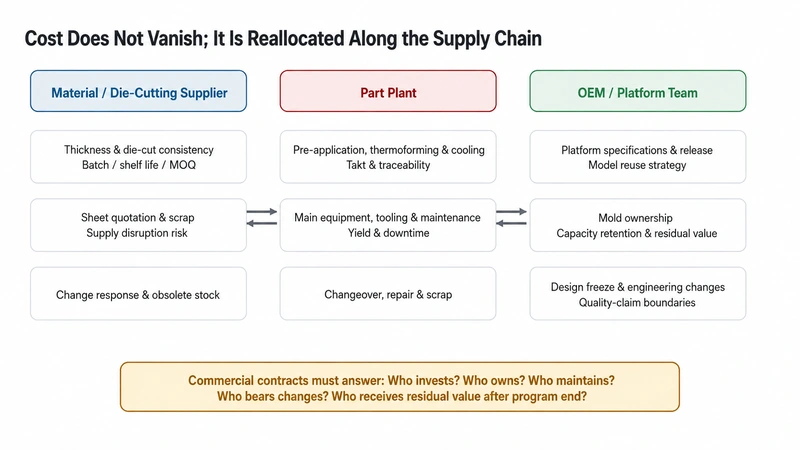
Figure 1 | After conversion to film, cost is redistributed among the material supplier, component plant and vehicle-platform team
Prepared from key project screenshots, the PPT cost boundary and the tooling-investment assumption provided by the user.
In a commercial review, split capital expenditure into five wallets instead of one “equipment cost”: shared primary equipment, part-specific dies, part-specific fixtures, part-specific activation tools/adapters, and installation/validation plus working capital. Only then can platform reuse and engineering changes be priced accurately.
| Contract topic | Definition that must be explicit | What happens if it is not |
|---|---|---|
| Price boundary | Whether the cut-piece price includes coating, die-cutting, equipment depreciation, packaging and scrap | The same investment is counted in both quotation and CAPEX |
| Tool ownership | Ownership of dies, fixtures and press heads; transfer and residual value after program termination | Tools cannot move with a supplier change, or investment must be repeated |
| Capacity commitment | Shared-equipment capacity, priority, OEE baseline and expansion trigger | New programs take cycle capacity from existing programs |
| Engineering change | Change classification, quotation timing, obsolete material and revalidation responsibility | Small changes before or after SOP become large unplanned expenses |
| Quality claim | Responsibility boundaries for incoming material, positioning, heat pressing, cooling and substrate | Failures cannot be attributed quickly from data |
Table 2 | Five foundational commercial clauses for an adhesive-film project.
2. Upgrade ROI from single-project arithmetic to platform-portfolio investment
The updated actuarial model produces an apparently unfavourable baseline. With one part type, film requires RMB 2.4 million in incremental initial investment, saves RMB 544,800 in first-year operations, has a simple payback of 50.9 months and a five-year NPV of -RMB 128,000. This conclusion must be retained because it prevents a team from manufacturing a false return by understating tooling investment.
A platform decision cannot stop there. The RMB 2 million shared primary machine is purchased once. Each additional part type with the same annual volume and unit saving adds an RMB 1.2 million dedicated die and corresponding toolkit, while also adding operating savings. Under the demonstration assumptions, five-year NPV becomes approximately RMB 943,900 with two part types, RMB 2.0159 million with three, and RMB 3.0879 million with four.
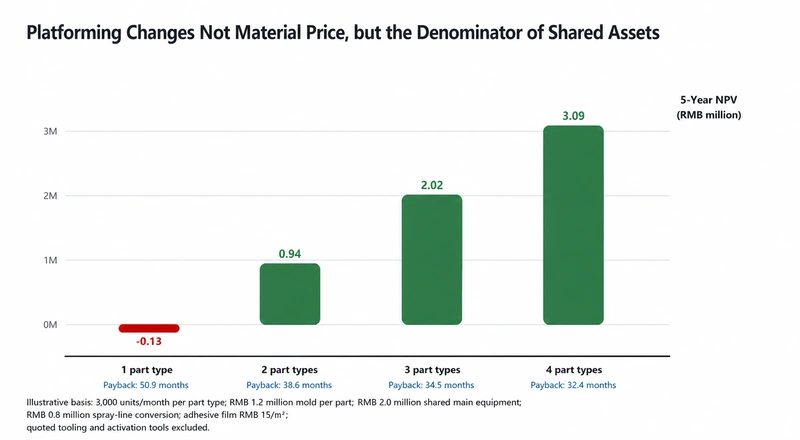
Figure 2 | From one to four part types: NPV and payback improve as more projects share the asset
Simulation: 3,000 vehicles/month per part type, 12 operating months/year, RMB 544,800 first-year operating saving per part type, 2% general cost escalation, 8% discount rate, RMB 2 million shared primary equipment, RMB 1.2 million die per part type, and one-time RMB 800,000 spray retrofit. Fixtures and activation tools are excluded because formal quotations are still pending.
A more mature financial model should maintain a “part-family ledger,” one row per part type, recording SOP, EOP, annual volume curve, bonded area per vehicle, film price, dies/fixtures, minutes of shared-equipment occupancy, change probability, residual value and exit cost. Platform NPV is not a simple average; it is the combined cash flow under one capacity constraint. In this simulation, NPV break-even lies between one and two part types. Interpreted as whole projects, at least two part types with similar volumes and savings are needed to cross the five-year zero-NPV threshold.
3. The technical definition of platform standardization: share the core, not physical facts
“Equipment can be shared across vehicle programs” is often oversimplified. The primary machine can be shared, but press heads, dies, heat fields and process windows cannot simply be copied. True platform standardization has four parts: a common equipment-safety architecture, modular tool interfaces, a common control-recipe structure, and common data fields and decision logic. Part geometry, die-cut contour, local pressure distribution and each substrate-film combination still require dedicated validation.
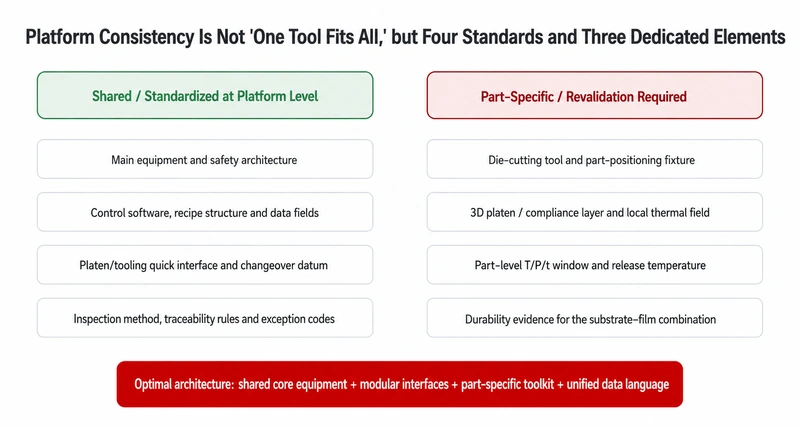
Figure 3 | The correct platform boundary: share core equipment and data language while retaining part-specific toolkits and validation evidence
Original architecture diagram combining equipment-sharing, non-shared tooling and technical-quality gates from the project PPT.
This architecture creates two direct benefits. First, changeover is no longer “develop a new process”; it becomes loading the part recipe, replacing the modular toolkit and verifying version match. Second, data become comparable across vehicle programs. Common exception codes, process fields and capability metrics allow engineering teams to identify systemic issues instead of maintaining a separate explanation for every program.
- Platform equipment specification: maximum pressure, number of heat zones, temperature-control accuracy, cooling capability, safety interlocks, data-sampling frequency and interface protocol.
- Tool-interface specification: datums, quick change, identification code, error-proofing, connectors, compliant press-head layer and maintenance life.
- Recipe-data specification: part number, material combination, die-cut version, temperature/pressure/time, demould temperature, tolerances and permissions.
- Quality-language specification: defect codes, sampling items, reaction plan, containment scope and traceability granularity.
4. The engineering-change tax of film: the later design freezes, the more platform value it consumes
Spray boundaries can be adjusted to some extent on site through masking, gun path and coat weight. Film contours are fixed at die-cutting. That makes their boundaries more consistent, but also makes late engineering changes more expensive. If class-A surfaces, wrapped edges, adhesive zones, vent paths, positioning datums, radii or tolerance chains change after tool release, the change may simultaneously trigger a new cutting die, locating fixture, 3D press head, heat field, DOE, durability validation and obsolete inventory.
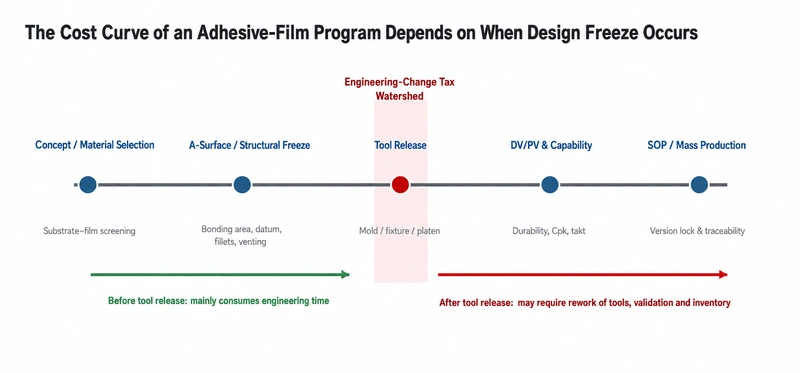
Figure 4 | Tool release divides the engineering-change tax: later changes affect more assets and evidence
Original APQP illustration; specific milestones must align with the customer’s development process.
An adhesive-film project should therefore bring the “manufacturable adhesive zone” into product definition early instead of asking the process team to recover after styling and structure are fully frozen. Complete the adhesive-zone manufacturability review before class-A and structural freeze, and classify changes as recipe-only, die-cut contour, tooling or material-system changes. Each level should have its own cost, validation depth and approval authority.
5. Quality consistency and traceability: bind process variables to every part
Film is often described as “stable thickness, stable boundaries and no shop-floor spray.” These benefits become automotive-quality assets only when converted into a part-level evidence chain. The valuable fact is not that temperature and pressure once appeared on an equipment screen. It is the ability to answer: Which film batch did this part use? Which die-cut version? How long did it wait after substrate treatment? Was the press curve inside the window? What was the temperature at release? What was the final inspection result?
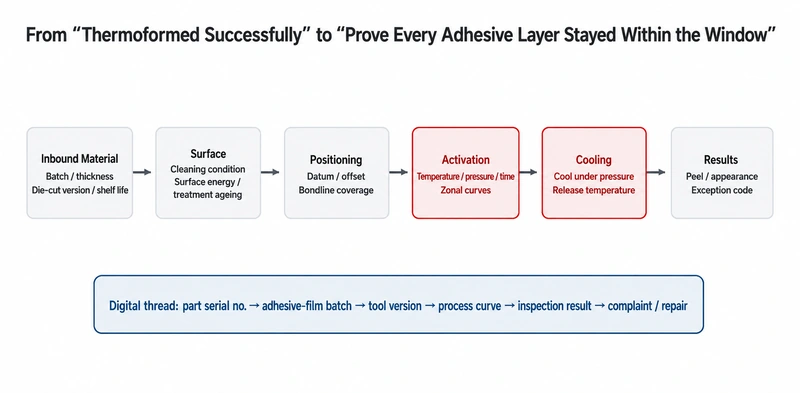
Figure 5 | Part-level digital thread binding material batch, tool version, process curve and result
Original traceability architecture. Field scope must follow customer traceability granularity, equipment capability and data-governance requirements.
Key quality characteristics should be divided into three layers. Material CTQs include thickness, coat weight, die-cut dimensions, batch and shelf life. Process CTQs include surface condition, positioning offset, zone temperature, pressure, time and cooling under pressure. Product CTQs include peel/shear, edge condition, bubbles, appearance, optical performance and retention after aging. All three layers should be traceable through the same part serial number.
| Control layer | Must be recorded | Typical release evidence | Value during an exception |
|---|---|---|---|
| Material | Film batch, thickness/coat weight, die-cut version, expiry | Incoming report, dimensional capability, batch sampling | Quickly contain supplier batch and inventory scope |
| Surface | Cleaning method, treatment parameters, wait after treatment | Surface energy/wettability and elapsed-time validation | Separate substrate contamination from film/press issues |
| Heat press | Zone temperature, pressure, time, release temperature | Window map, Cpk, alarms and retained curves | Determine whether the part actually experienced a qualified window |
| Result | Appearance, peel/shear, defect code, repair | DV/PV, production sampling and reaction plan | Narrow containment and close the learning loop |
Table 3 | Minimum data set for the adhesive-film quality digital thread.
6. Cycle time and capacity: after the spray booth disappears, bottlenecks move to heating, cooling and logistics
Film does not automatically eliminate all labour or increase capacity. When spraying, flash-off and gun cleaning are compressed, new bottlenecks may appear in pre-positioning, press heat-up, cooling under pressure, part handling and changeover. For complex 3D parts in particular, heat input and cooling time cannot be reduced indefinitely without risking substrate and appearance damage.
Once platform equipment is shared, it should be managed as a capacity pool. Allocate equipment minutes by part family and define peak-program priorities and capacity-expansion triggers. Before investment, run three stress cases: annual average load, monthly peak load, and degraded production during failure or maintenance. Low utilization weakens ROI, while excessive utilization amplifies downtime risk. The objective is not 100% loading, but a deliberately designed buffer between economics and resilience.
- Changeover: toolkit identification, error-proofing, preheating/cooling, first-off confirmation and parameter permissions must be included in cycle time.
- Parallelization: dual stations, rotary fixtures or offline pre-positioning can reduce primary-machine occupancy, but add WIP and error-proofing needs.
- Maintenance: press-head compliance layers, heating elements, temperature sensors, pressure calibration and fixture datums belong in preventive maintenance.
- Contingency: when critical equipment stops, determine whether a backup station, cross-line transfer or validated temporary process exists.
7. Supply chain and inventory: from “universal adhesive in drums” to “part-specific cut pieces”
Film cut pieces bind material, geometry and version. The benefit is inspectable incoming material with a defined boundary; the cost is more SKUs, MOQ exposure, obsolete stock and version-switch risk. One drum of spray adhesive can cover several parts. Film may create multiple dedicated part numbers because of contour, thickness, release method or packaging orientation. If platform standardization covers equipment but not material families and cut-piece rules, inventory complexity can offset shop-floor gains.
Establish a “material-family strategy” during sourcing. Standardize film grade, thickness series, release system, roll width/cut-piece packaging and label fields wherever possible, keeping only the die-cut contour dedicated. VMI, rolling forecasts, tiered minimum-order quantities, engineering-change return/reuse mechanisms and explicit safety-stock ownership can reduce working capital and obsolescence risk.
| Supply-chain risk | Required control | Suggested metric |
|---|---|---|
| MOQ and obsolescence | Rolling forecast, tiered MOQ, return/reuse rules after change | Inventory turns, E&O value, scrap rate |
| Shelf life and storage | Temperature/humidity, FIFO, batch status, open-package limit | Near-expiry share, expired batches, condition excursions |
| Dedicated-SKU growth | Material-family standard, cut-piece naming and version cleanup | SKUs per vehicle program, share using common grades |
| Single source | Reserved capacity, backup die, second-source validation route | Days of interruption, recovery time |
| Change cutover | Old/new version segregation, switch point and serial trace | Mixed-material incidents, obsolete value, cutover yield |
Table 4 | Four new film supply-chain cost groups and their management metrics.
8. EHS, LCA and sustainability: move from “no spray” to a complete material and energy balance
Film reduces shop-floor spray, gun cleaning and part of the ventilation and filtration burden. That is attractive, but it is not the same as “zero environmental burden.” Heat pressing consumes energy, cut pieces use release liners and create die-cut trim, dedicated inventory can become scrap, and upstream film coating occurs at another plant. A responsible technical conclusion must separate site improvement from the full lifecycle boundary.
Build two tables in parallel: a site EHS difference table and a lifecycle material/energy table. The first records ventilation, filtration, cleaning, liquid waste, occupational exposure and fire management. The second records energy per square metre of film, release-liner destination, die-cut utilization, scrap and transport. Only with the same system boundary can the lower-carbon or lower-waste route be discussed. Project EHS should confirm applicable versions of regulations and standards based on formulation, place of use and customer requirements.
9. Risk costing: separate low-frequency, high-loss events instead of hiding them in an average
Traditional ROI often compresses quality, downtime and supply interruption into an “other cost” percentage. The result is neither auditable nor improvable. A method better suited to automotive programs separates each event into exposure, probability and loss per occurrence: expected annual loss = annual exposure × event probability × average loss per event.
On the spray side, examine occupational exposure, product contamination, storage failure, fire/hazardous-material management, undetected incoming abnormalities, equipment downtime and rework/scrap. On the film side, add heat damage to thermally sensitive substrates, tool changes, obsolete dedicated inventory, equipment-capacity bottlenecks and supply interruption. Without reliable data, do not insert a falsely precise amount. Keep low/medium/high scenarios and state how many months of site records are needed to close the uncertainty.
| Risk event | Exposure | Probability basis | Severity basis | Decision use |
|---|---|---|---|---|
| Production downtime | Events/equipment hours | Maintenance records and OEE | Stopped minutes × capacity loss | Backup capability and maintenance strategy |
| Batch scrap | Batches/annual volume | Incoming and process history | Material + processing + disposal + delivery impact | Traceability granularity and sampling |
| Engineering change | Part-version count | Program change history | Tool remake + revalidation + obsolete material | Freeze point and change contract |
| Supply interruption | Supplier/critical part number | Delivery and capacity data | Shortage downtime + expediting + transfer | Dual source and safety stock |
Table 5 | Model risk events through frequency and severity without double-counting deterministic cost.
10. Not every part should move to film immediately: choose the right battleground
The best early candidates are not simply parts with the largest bonded area per vehicle. They are part families with sufficient platform scale, stable design, clear quality pain points and interfaces that can be shared. Conversely, low-volume projects with frequent changes, unfrozen geometry or unclear repair routes can be overwhelmed by tooling and change tax even when material performance is strong.
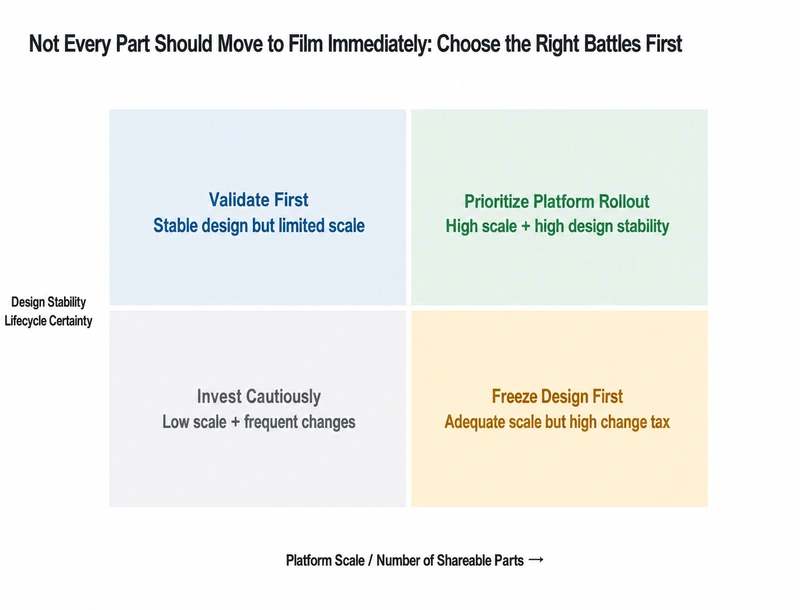
Figure 6 | Film-introduction priority: platform scale and design stability must be considered together
Original decision matrix. Actual projects must also consider material compatibility, quality risk, capacity and supply assurance.
Classify candidates as platform launch parts, fast-replication parts and watch-list parts. Launch parts validate equipment architecture and common data. Fast-replication parts reuse the primary machine, interfaces and material family wherever possible. Watch-list parts wait for design freeze or volume confirmation. This builds the platform early without consuming first-round confidence on unstable projects.
11. Production roadmap and technical-release thresholds: eight gates turn “want to replace” into “ready to replicate”
Film replacement should not end with one A/B trial. Its deliverable should be platform replication capability. The eight gates below are both the implementation roadmap and the technical-release thresholds from material approval through process validation to production approval:
- Portfolio gate: define the launch part, replication parts and platform annual volume; do not make one part carry all shared investment.
- Commercial gate: lock the price boundary, whether equipment is included in the quotation, tool ownership, change responsibility and residual value.
- Design gate: freeze adhesive zone, locating datums, tolerance chain, venting and repair strategy before tool release.
- Material gate: complete substrate-film screening, storage/aging validation and supply assurance.
- Process gate: rebuild the T/P/t window, press-head compliance, heat field and demould-temperature gate on the actual part.
- Quality gate: complete DV/PV, appearance/optics, durability, peel/shear and failure-mode closure.
- Capacity gate: calculate equipment count from occupancy cycle, OEE, peak portfolio and degraded operation.
- Data gate: connect part serial number, film batch, tool version, process curve and inspection result.
Conclusion: film wins by building a more complete platform, not by portraying spray as worse
Film’s most persuasive feature is not a slogan such as “more advanced material” or “cleaner shop floor.” It is a route for turning a bond line from shop-floor experience into a platform asset: incoming material defines the boundary, a window controls the process, results are bound to each part, several parts share the equipment, and a common data language replicates learning.
The route has real thresholds. The user-experience value of approximately RMB 1.2 million for one part-specific die must enter cash flow. Fixtures and activation tools need formal quotations. Design freeze must move earlier. Capacity and supply chain must be calculated at platform level rather than by one vehicle program. Ignoring these costs undermines trust after launch; confronting them allows film to grow from a material selling point into an operating capability.
Sources and calculation basis
- User-provided key screenshots covering visible cost—usage, waste and spray labour—and hidden cost—retrofit, activated carbon, floor space, health, contamination, storage, warehouse, incoming material and maintenance.
- Adhesive Film vs Water-Based Spray Adhesive: A RMB 2 Million Equipment Investment Buys a Repeatable Process, Not Just Adhesive (first article, 2026-08-30), used only to identify coverage and avoid repetition.
- Adhesive Film vs Water-Based Spray Adhesive: RELANET ROI, 20260731 and Adhesive Film vs Water-Based Spray Adhesive: Technical Root Causes and ROI, RELANET, 20260731.
- Actuarial ROI Model for Adhesive Film vs Spray Adhesive (updated assumption: RMB 1.2 million die per part; fixtures and activation tools pending formal quotation).
- User-experience input: one part-specific die is approximately RMB 1.2 million. This is a modelling input, not a substitute for a formal quotation.
- The first article’s EPA reference, adhesive-film supplier literature, GB 33372-2020, GB/T 27630-2011, HJ/T 400-2007 and GB/T 40726-2021. Actual projects must confirm applicable scope and current versions.
Disclaimer: all financial figures in this article are project calculation examples and do not constitute an investment commitment. Technical parameters, regulatory applicability and production conclusions must be based on formal quotations, site data, project validation and customer approval.