
Begin adhesive selection with the bonding surfaces and the part geometry. A PUD designation or a film's appearance does not replace project evidence. Define where the bond acts, when it must hold and how it will be evaluated.
Identify the surfaces that contact the adhesive
Map the skin, backing, foam, carrier and each adhesive interface. Record grades, batches, thicknesses, coatings and existing treatments. The labels PVC, PU, TPO, PP or ABS do not establish identical bonding surfaces.
Separate cleaning from surface activation. Validate the proposed treatment with the actual material and adhesive system. Record the interval from treatment to coating and bonding; do not prescribe or omit primer from the material name alone.
Include springback in specimen design
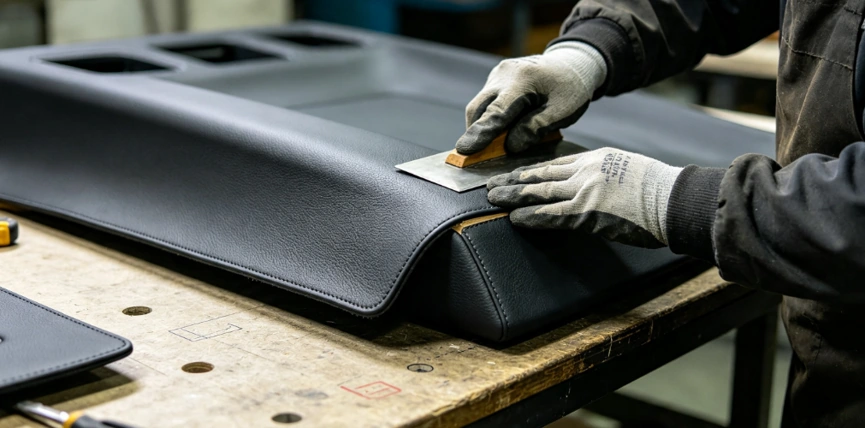
Mark flat areas, recesses, stretched regions and wrapped edges. Record skin direction, springback, fixture contact and release sequence. Flat peel specimens help compare interfaces but cannot replace holding observations at these locations.
Use representative curves or wrapped edges to inspect contact and deformation. Retain photographs and observation times after support is removed. Distinguish material tension from changes in the bonded area; preserve a lifted-edge specimen before assigning a cause.
Separate tack, holding and peel measurements
Initial tack describes immediate grab under defined contact conditions. Early holding relates to handling, transfer or release. To quantify initial bond strength, define an early test time, specimen width, peel method and peak or average reporting.
Final strength needs its own drying or curing, conditioning and measurement time. A part that releases from a tool or temporarily stays in position is not proof of complete cure or final peel performance. Use current issued instructions for the specific product.
Use both failure faces to plan the next check
Photograph corresponding faces from the same location. Distinguish separation at the carrier, failure within adhesive and tearing of foam or skin. Substrate failure alone does not prove that every interface is acceptable; a good appearance is not a strength measurement.
Link specimen identity to coating, drying, activation, pressing and release records. Keep unaged controls and repeated specimens for abnormal groups. Select the next variable deliberately rather than attributing several simultaneous changes to the formulation.
Validate and discuss the actual part
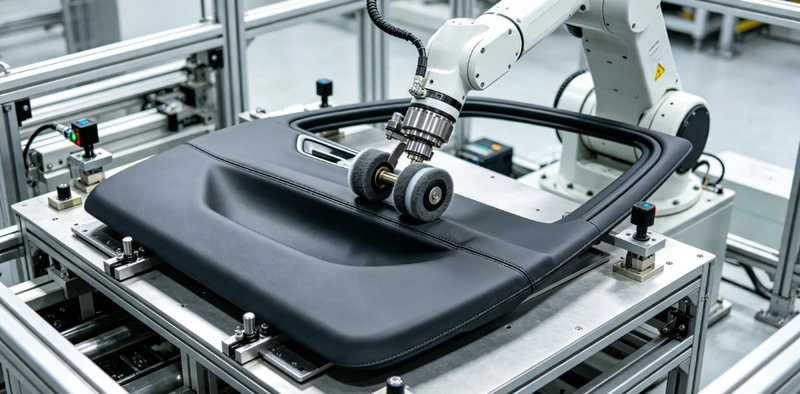
Agree separate methods for appearance, adhesion, heat under load, humidity and other durability requirements before entering results. Keep missing records or limits pending. Results from another material pair are not release limits for this part.
Send RELANET the layer stack, actual surfaces, defect locations, process records and customer requirements. Request current component TDS and SDS. Record sample evaluation separately from production approval, without assuming a custom-sample deadline or guaranteed outcome.
Continue with material and process records
Use the surface-treatment guide to organize surface conditions and the door-trim evaluation page for wrapped edges. For trial planning and change records, read the PUD process-evaluation guide.
Separate odor, VOC and durability validation
NES M0160 covers odor testing of automotive interior parts. It does not replace VOC, cabin air-quality, durability or regulatory assessment. Confirm the revision, sample, conditions and project targets. Naming a standard does not prove a pass.
- Use the customer-specified NES M0160 revision and odor test conditions. Any stated grade requires a valid report for the corresponding sample.
- Confirm VOC methods and targets separately. Nissan projects may involve NES M0402 and NES M0403. GB/T 27630 covers passenger-vehicle cabin air quality; it is not a single adhesive VOC limit. Check REACH, ELV and durability requirements separately.
Sources and validation basis Nissan · NES M0160 / NES M0402 / NES M0403