
RELANET · Updated
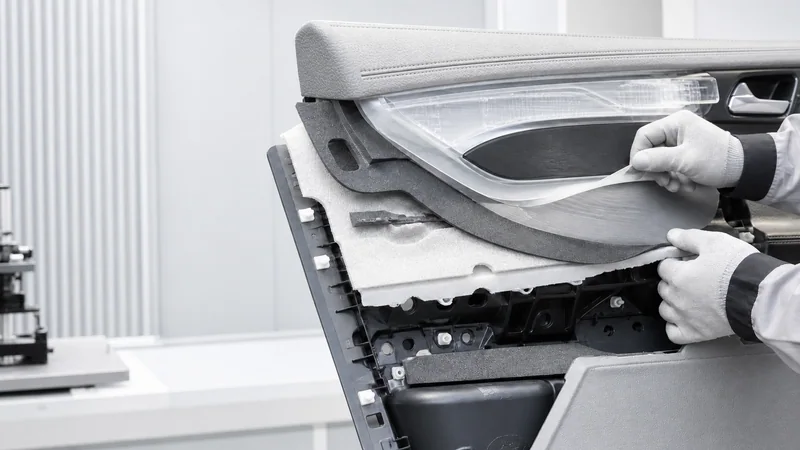
Identify the door trim layer stack
Describe the covering and its backing, any foam layer and the carrier grade. Mark which surfaces receive adhesive and where the covering turns around an edge. Include cutouts, seams and changes in curvature when defining the evaluation area.
Keep material thickness and backing treatment in the trial record. A visually similar trim construction may present a different bonding surface, so samples should represent the materials proposed for production.
Assess PP and ABS by grade and surface condition
Do not decide pretreatment solely from the labels PP or ABS. Record the grade, molding conditions where relevant, visible contamination, release agents and any existing treatment. Establish a cleaning procedure before comparing further surface preparation.
Cleaning and activation serve different purposes. If flame, plasma or a primer is proposed, verify the substrate–treatment–adhesive combination and the time between treatment and bonding. Neither a single dyne value nor an initial adhesion result establishes durable compatibility.
Record coating, drying and pressing as separate steps
Define the application method, coated sides and coating measurement basis. Check coverage on both the broad area and the wrapped return. Document drying conditions separately from any activation step; use the current product instructions to establish the starting trial conditions.
During pressing or wrapping, record temperature where relevant, pressure, contact time and tool release timing. Identify the point at which the part must hold its shape without external support. A process window should come from repeatable trials.
Inspect edge springback and the location of separation
Photograph edges and curved areas after release, after the specified cure and after aging. If an edge lifts, identify whether separation occurs at the carrier, covering, foam or within the adhesive layer before changing the formulation or process.
Compare broad-area peel with representative edge geometry rather than using one to replace the other. Record the extent and location of lifting, foam tearing, coating transfer and any appearance defect so corrective trials address the observed interface.
Prepare a focused product and sample request
R-5670/R-60C is a candidate for discussion, not an automatic approval for every door trim stack. Request current component TDS and SDS, then describe material grades, pretreatment, equipment, cycle timing and the customer's aging and appearance requirements.
Include whether the project is a new development or a failure investigation. For an investigation, supply representative good and failed samples with process records; this makes it possible to compare actual conditions before selecting a corrective trial.
Questions and answers
Is this adhesive information for exterior door panels?
No. The scope is interior door trim covering, foam and carrier lamination or wrapping.
Does PP always require a primer?
The preparation route must be established for the actual grade and adhesive system. Do not prescribe or omit a primer solely from the generic material name.
Why does the flat area pass while an edge lifts?
The edge has a different geometry and holding demand. Inspect its coating, process record and failure interface, then test a representative wrapped specimen.