
Water-based PUD adhesives can be considered for instrument panels, door panels, seat trim and headliners. Test adhesion, temperature response, humid-heat durability, appearance, processing and odor/VOC for the chosen grade and actual materials. Material category or country of origin does not establish a product's performance rank.
RELANET develops water-based polyurethane adhesives for automotive interiors. R-5670 and R-5610 serve different wrapping and illuminated-trim applications. This page keeps six evaluation areas and the original comparison material for early review. Check the grade, sample, method and original report behind each figure. The material does not prove performance across every grade, competitor rankings or project guarantees.
Preface: industry test framework
The original material cites GB/T 2792-2014 peel testing and ASTM D412 tensile testing. It also cites humid-heat exposure at 60°C/95% RH and cycling from -40°C to 105°C. Check the applicability and records for each method or condition separately. Use the customer-specified NES M0160 for odor. Confirm VOC, cabin air quality and regulations separately. Verify the full test basis before using the comparisons below.
Competitor A; Competitor B; a benchmark PUD; and imported Competitor C. The competitor identities are anonymized in the source manuscript.
The RELANET test sample was R-5670 interior PUD, described as the main commercial model. All samples were crosslinked for 24 hours at 23°C. Each used a 100:5 ratio of water-dispersible isocyanate hardener. The chart descriptions below match the original manuscript figures.
Evaluation 1: bond strength, substrate adhesion and edge lift
Door-panel folds, instrument-panel curves and seat coverings need peel and durability tests that match their loads. PP, TPO and leather grade, backing and surface condition affect the interface. A single 180° peel result cannot predict installed service life.
Measured comparison data (N/m, 180° peel strength)
Table. Adhesion of four product groups
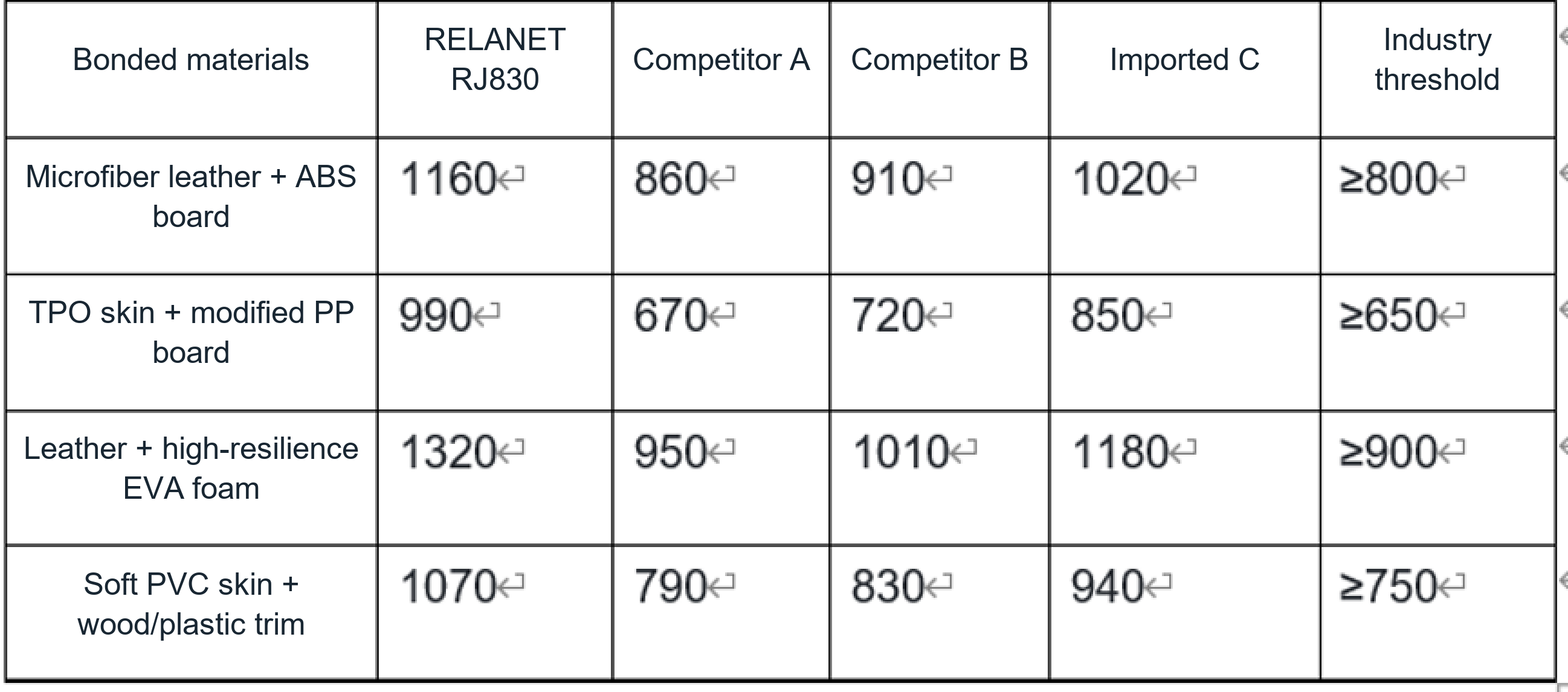
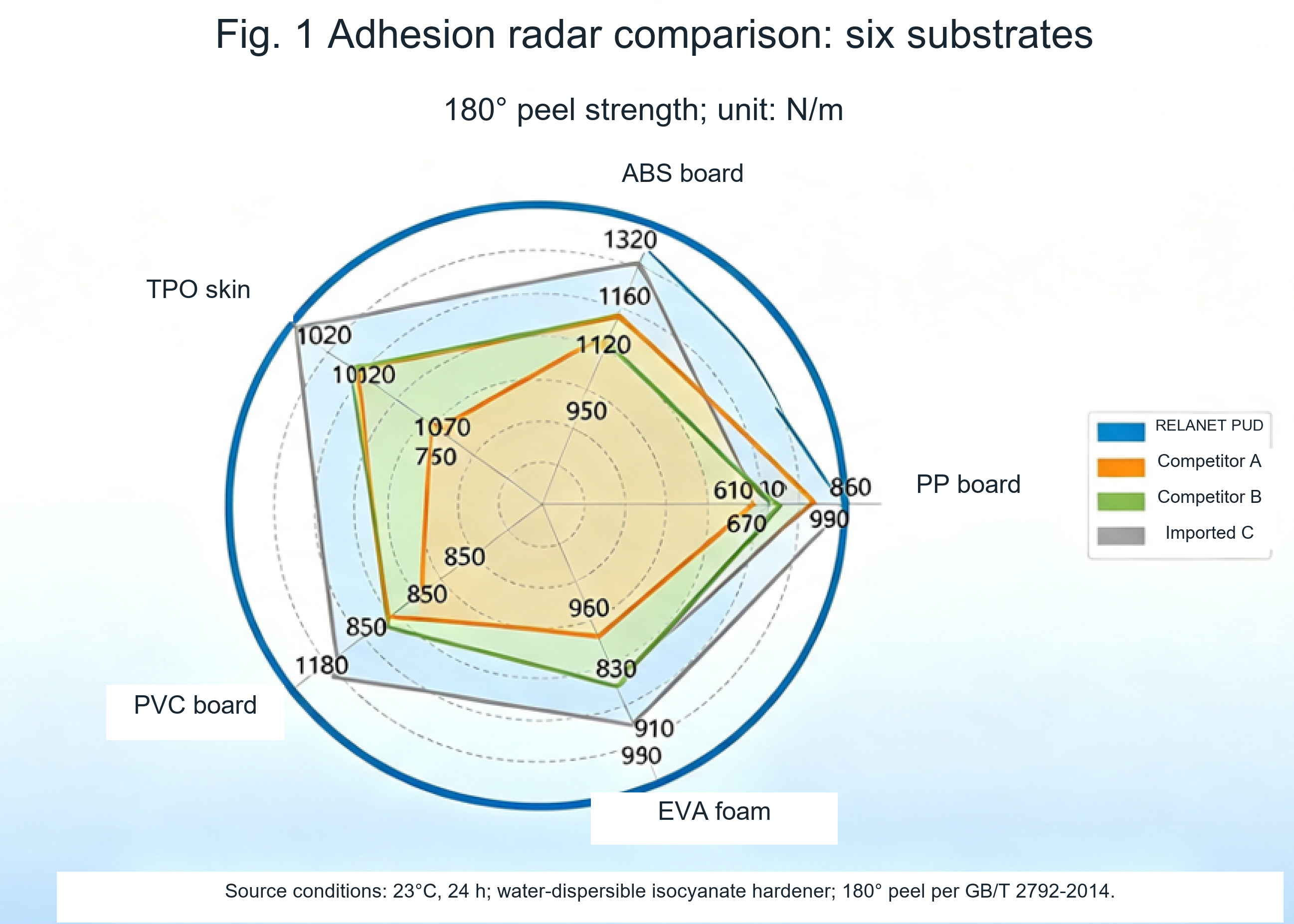
The diagram covers ABS, PP, leather, foam, PVC and TPO. Before comparing results, check each axis's units, samples, pretreatment and original reports. The figure does not prove compatibility with every substrate or a product ranking.
Interpretation
Molecular design alone cannot prove PUD bonding of PP or TPO without pretreatment. Check cleaning, primer or activation for each grade. Follow R-5610 technical requirements for PP and IXPP.
R-7206 and R-7110 are separate modified-polyolefin hot melts. They can omit primer, flame or plasma on confirmed PP grades with clean surfaces and validated processes. Verify the original cost, peel and cycling records separately. Do not apply them to the whole PUD range.
Evaluation 2: temperature response from -40°C to 105°C
Vehicle cabins face a wide temperature range. Northern winters can reach -30°C or -40°C. A closed cabin in summer sun can exceed 100°C. Conventional PUDs may harden and crack in the cold or soften and become tacky in heat. RELANET adjusts the film's glass-transition behavior to widen its operating range.
Peel-strength retention across the temperature gradient
- 1. After 24 hours at -40°C, reported peel-strength retention was 92% for RELANET. It was 71% for Competitor A, 76% for Competitor B and 83% for imported Competitor C.
- 2. After 24 hours at 105°C, reported peel-strength retention was 88% for RELANET. It was 66% for Competitor A, 70% for Competitor B and 79% for Competitor C.
- 3. After 100 thermal cycles between -40°C and 105°C, the RELANET sample retained 85% strength with no delamination. The three comparison products showed local edge lift and retained 58%-72%.
Figure 2. Peel-strength retention across the full temperature range
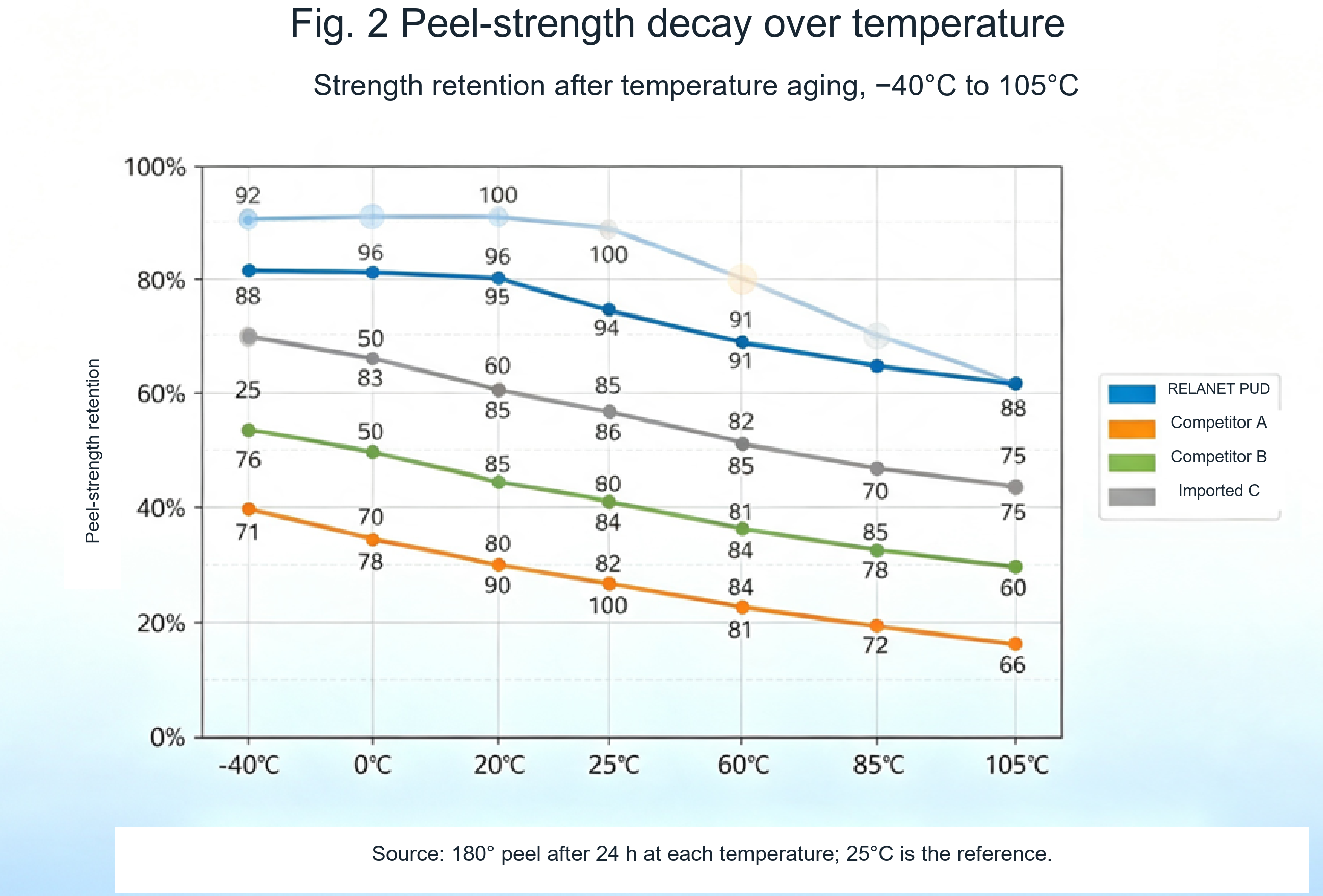
Temperature is on the horizontal axis; peel strength is on the vertical axis. The blue RELANET curve falls gradually. Competitors A and B fall sharply at low temperature. Imported Competitor C falls more at high temperature.
Interpretation
The RELANET film's reported elongation at break is up to 850% at room temperature. At 10°C, it retains 500%-800%, compared with 300%-500% for the comparison set. This flexibility helps prevent leather tearing during manual wrapping in cold workshops. It also reduces cracking in severe winter use. In summer heat, the layer is designed to resist flow and oil bleed into the skin.
The manuscript cites series-production applications in both cold northeastern and hot Hainan-region vehicle programs as evidence of broad climate coverage.
Evaluation 3: 1,000-hour humid-heat exposure and hydrolysis resistance
Humidity in South China and coastal areas can stay above 85% for long periods. Moisture can enter the bond line and cause hydrolysis, whitening, swelling and debonding. The source describes this as a common cause of interior aging after three to five years in coastal service. It contrasts the industry's commonly used 500-hour hydrolysis test with RELANET's reported 1,000-hour aging program.
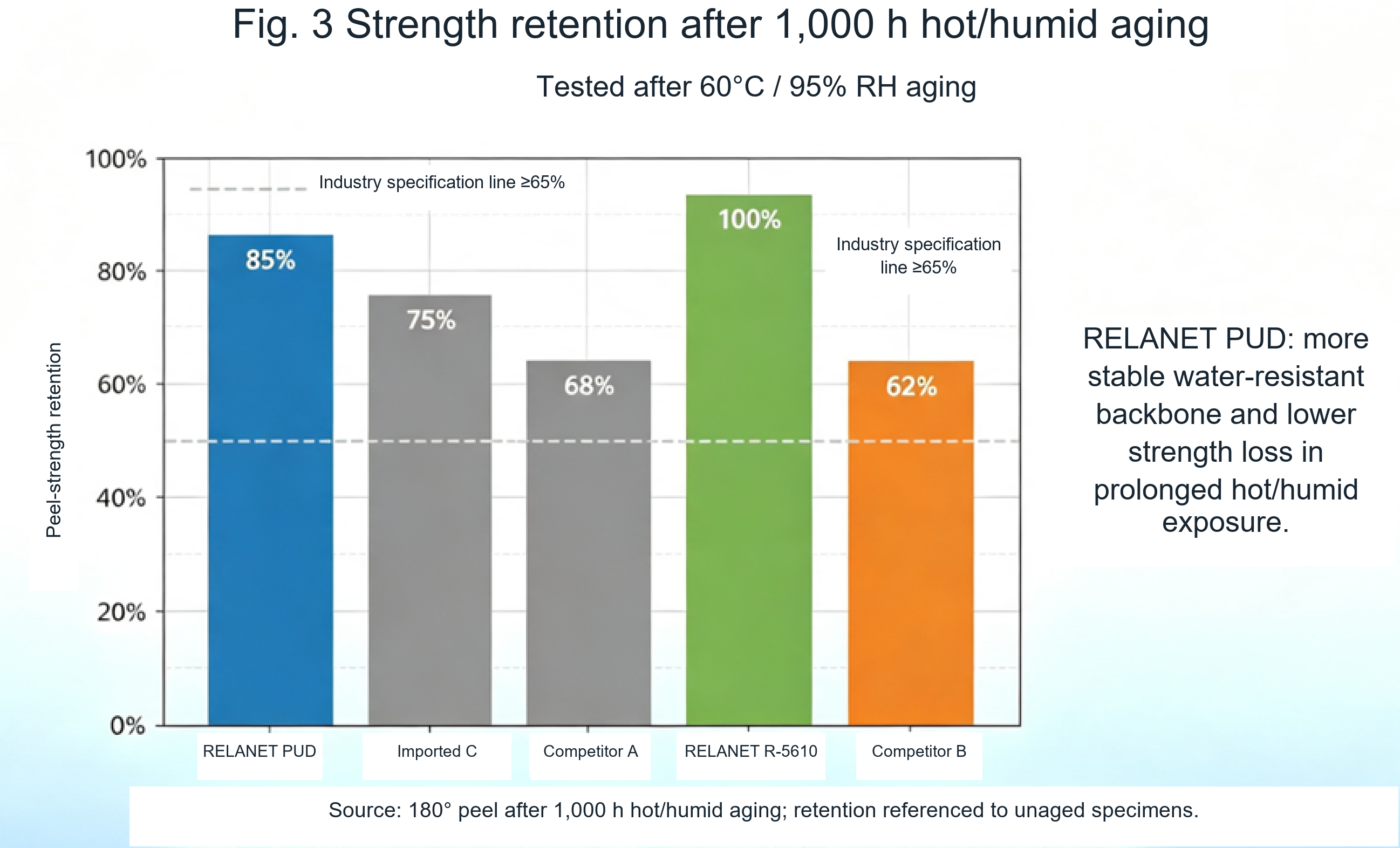
Measured aging at 60°C and 95% RH for 1,000 hours
- RELANET R-5670: the film remained clear, without whitening or swelling, and retained 85% of peel strength.
- Competitor A PUD: localized film whitening and 62% retained strength.
- Competitor B PUD: slight hydrolysis and 68% retained strength.
- Competitor C PUD: slight whitening and 75% retained strength.
The manuscript cites ≥65% retention as a commonly applied higher-level industry requirement.
Figure 3. Strength retention after 1,000 hours of humid-heat aging
Interpretation
RELANET uses a hydrolysis-resistant polycarbonate backbone instead of conventional polyester segments, which are more prone to hydrolysis. This makes it harder for water molecules to break down the polyurethane chain.
The manuscript cites production feedback from retrofit suppliers in the Pearl River Delta and coastal Fujian. Wrapped interiors reportedly stayed flat and secure after five years, without moisture-related blisters or detachment. The manuscript describes more than 40% longer service life than comparison products. It also reports a related drop in after-sales maintenance cost.
Evaluation 4: chemical, UV and yellowing resistance
White, cream and light-grey interiors are more common in new-energy vehicles. Aromatic PUDs can yellow under ultraviolet light. Neutral cleaners, hand cream and leather-care products may also reach the adhesive layer. They can cause swelling or debonding. Both issues need attention in the design.
Two dedicated test groups
- 1. Chemical-resistance test: 72-hour exposure to a neutral interior cleaner and silicone-oil care fluid.
RELANET: no swelling and less than 6% strength loss; Competitor A: 21% loss; Competitor B: 17% loss; imported Competitor C: 11% loss.
- 2. Yellowing-resistance test: 500 hours at 85°C plus 300 hours of ultraviolet aging.
RELANET: color difference ΔE <1.2, with no yellowing visible to the unaided eye.
Competitors A and B: ΔE >3.8, with obvious yellowing; imported Competitor C: ΔE ≈2.1, with slight yellowing.
Figure 4. Color-block comparison after yellowing exposure
Interpretation
An aliphatic structure can reduce yellowing. It cannot guarantee permanent color stability for every PUD grade or complete interior part. Test color change, cleaner contact, silicone oil and plasticizer migration separately for leather, TPO, microfiber and PVC. Record adhesive thickness, exposure, temperature, duration and failure mode.
Evaluation 5: process windows, material use and manufacturing cost
Strong laboratory results are not enough if an adhesive does not fit the line. RELANET tunes separate materials for manual and automated wrapping. The work addresses narrow activation windows, unsuitable open times, high drying energy and excess scrap. The figures below compare process parameters.
Table. Process-data comparison

Figure 5. Activation-temperature and open-time operating window
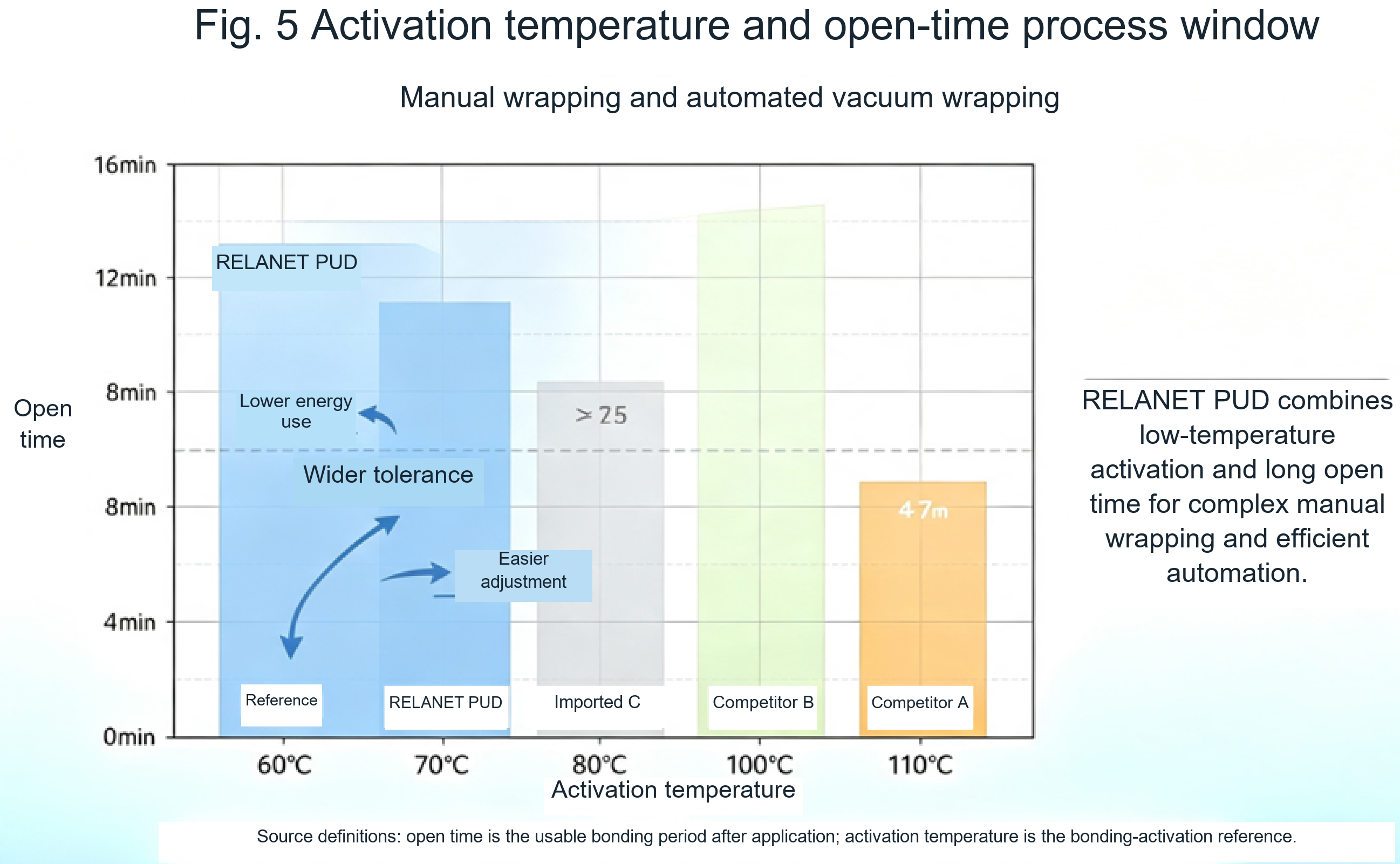
Figure description: the manuscript shows a wider RELANET operating region than the comparison regions and interprets it as greater process tolerance.
Interpretation
- 1. Manual wrapping: an 8-15 minute open time lets operators adjust skins over curves and irregular corners. After adoption in a South China winter workshop, the reported scrap rate among newly trained operators fell by 60%.
- 2. Automated production: the source reports a 20% oven-energy reduction with activation from 65°C. Thin leather and light-colored skins are less likely to shrink at this temperature. A 3-8 minute drying time can match the line cycle.
- 3. Material efficiency: the stated comparison uses 10%-20% less material per square metre because of lower coat weight. This lowers purchasing costs at scale. The dried film is transparent and leaves the leather grain visible, supporting interior appearance.
Evaluation 6: odor, VOC and regulatory requirements
Use the customer-specified NES M0160 for odor. Confirm VOC methods and targets separately. Nissan projects may involve NES M0402 and NES M0403. GB/T 27630 covers passenger-vehicle cabin air quality, not a single adhesive VOC limit. Check REACH, ELV and durability requirements separately. Naming a standard does not prove a test pass or regulatory approval.
Table. VOC comparison
Figure 6. Bar chart comparing VOC release
The source chart labels its red line as a national-standard limit. It places the reported RELANET value below that line and the comparison products. This label does not establish an adhesive VOC limit or compliance result.
Interpretation
A water-based formula can reduce the need for organic solvents. Odor, VOC, restricted substances and safety classification still need the grade's SDS and valid test data. Assess ventilation, exhaust treatment and fire protection for the whole line. Water-based chemistry does not mean zero emissions or an odor-free cabin. It does not remove the need for protective facilities. Customer applications and export suitability need authorized project and compliance records.
Combining the six evaluation areas for product selection
Combine the six areas in a validation record for the actual part. Cover initial bonding, temperature and humid-heat durability, appearance stability, process window and odor/VOC. Use the results together for selection. One passed test does not prove all properties, service life or a fixed cost saving.
RELANET can support selection, process tuning and aging tests for specific constructions, including PP/glass-fiber carriers and ultrathin leather. Compare candidates with equivalent specimens and conditions. Unverified charts or single results cannot prove overall superiority to another brand.
RELANET will continue to focus on water-based polyurethane for automotive interiors. Material technology, stable products and rapid local technical support help the shift to water-based processes. The goal is to work with automakers and interior suppliers to advance domestically developed bonding materials.
Separate odor, VOC and durability validation
NES M0160 covers odor testing of automotive interior parts. It does not replace VOC, cabin air-quality, durability or regulatory assessment. Confirm the revision, sample, conditions and project targets. Naming a standard does not prove a pass.
- Use the customer-specified NES M0160 revision and odor test conditions. Any stated grade requires a valid report for the corresponding sample.
- Confirm VOC methods and targets separately. Nissan projects may involve NES M0402 and NES M0403. GB/T 27630 covers passenger-vehicle cabin air quality; it is not a single adhesive VOC limit. Check REACH, ELV and durability requirements separately.
Sources and validation basis Nissan · NES M0160 / NES M0402 / NES M0403
R-7206 / R-7110: conditions for bonding PP without activation
R-7206 and R-7110 are modified polyolefin hot-melt adhesives. The non-polar polyolefin and PP systems are compatible. This helps explain direct bonding without primer, flame or plasma pretreatment. It applies to confirmed PP grades, clean surfaces and validated processes.
Skipping activation does not mean skipping cleaning. Control release agents, oil, dust, recycled content and surface condition. Then test peel, heat creep and aged durability on actual parts. These conditions do not cover every PP grade or load. Do not apply them to all PUD adhesives.