
RELANET · Updated
Map complex geometry and material interfaces
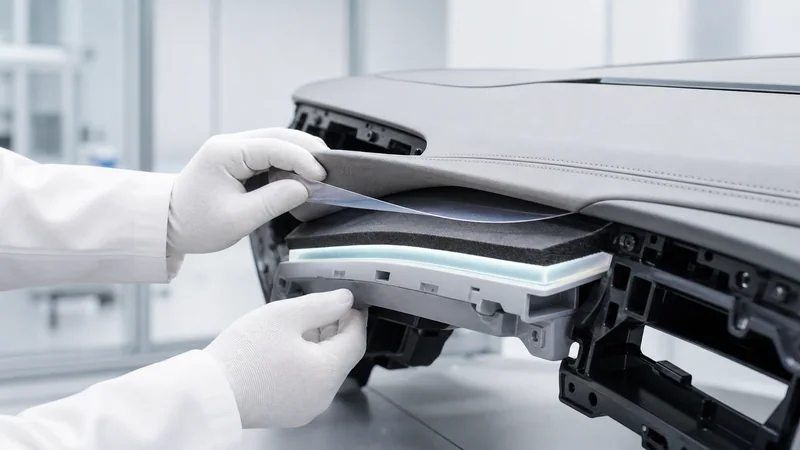
Provide the covering grade and backing, foam construction and carrier material. Mark changes in curvature, local draw, edge returns and areas with restricted contact during pressing. Use a drawing or clearly labeled sample to connect each observation with a location.
Choose both simple interface coupons and representative shaped areas. The first helps compare the material combination; the second helps evaluate coating access, forming, holding and appearance under the intended process.
Describe the spray and wrapping process
Record application equipment, coated sides, coating measurement basis and handling time between stages. Check whether recesses and edges receive the intended coverage. Include fixture design, pressing or forming sequence and the point when the part is removed from support.
If vacuum forming, deep drawing or IMG is involved, identify the process explicitly. It becomes an input for evaluation rather than a claim that the candidate adhesive already supports that method. Establish capability through relevant documented trials.
Distinguish drying from activation
Drying addresses the condition of the applied adhesive layer before bonding. Activation, where required by the system, is a separate preparation for bonding under specified conditions. Record the equipment setting and the relevant material-surface condition rather than assuming they are identical.
Use the current issued instructions as the starting point and validate the window on the actual stack. Track time between coating, drying, activation and pressing, including interruptions that may occur on the line.
Evaluate holding after release and investigate visible defects
Observe representative regions immediately after tool release, after the agreed curing period and after required conditioning. Record lifting, bubbles, local separation and changes in surface appearance. Keep the location and time of first observation with the process record.
For a defect investigation, examine where the bond separated and compare material batches, coverage, drying, activation and pressure. A visible bubble alone does not identify a single cause. Change defined variables in a controlled comparison and retain both acceptable and failed samples.
Define the project evidence and safety-related boundaries
Request the current TDS and SDS for a proposed R-5670/R-60C trial and agree on appearance, adhesion, aging and handling criteria. Any values from the existing product page require their stated conditions and document verification before being used in your process.
Adhesive test results do not qualify an airbag system. Where the trim intersects an airbag deployment area, the responsible customer must define and verify the complete assembly requirements. This page makes no airbag compliance or deployment-performance claim.
Questions and answers
Does a flat peel test establish wrapping performance?
It helps evaluate a defined interface but does not reproduce the geometry and release sequence. Include representative shaped-part trials.
Can equipment temperature be used as the activation condition?
Record the equipment setting and the relevant surface condition separately, following the issued instructions and a validated measurement approach.
Does adhesive approval establish airbag compatibility?
No. Safety-related assembly and deployment requirements need the responsible customer's separate system verification.