
VOC, odor and report review
How to Read Water-Based PU Adhesive Reports for Automotive Interiors
Nine SGS documents for R-5670: match each result to its sample and project
One R-5670 report gives VOC content of 2 g/L; other reports state ND for emissions. These results do not contradict each other: their specimens and methods differ. Review odor, VOC, ELV-related substances and REACH separately, then check the sample, paired components and preparation conditions against the project. An adhesive-sample report cannot establish compliance of a complete interior component or vehicle. [1–4]
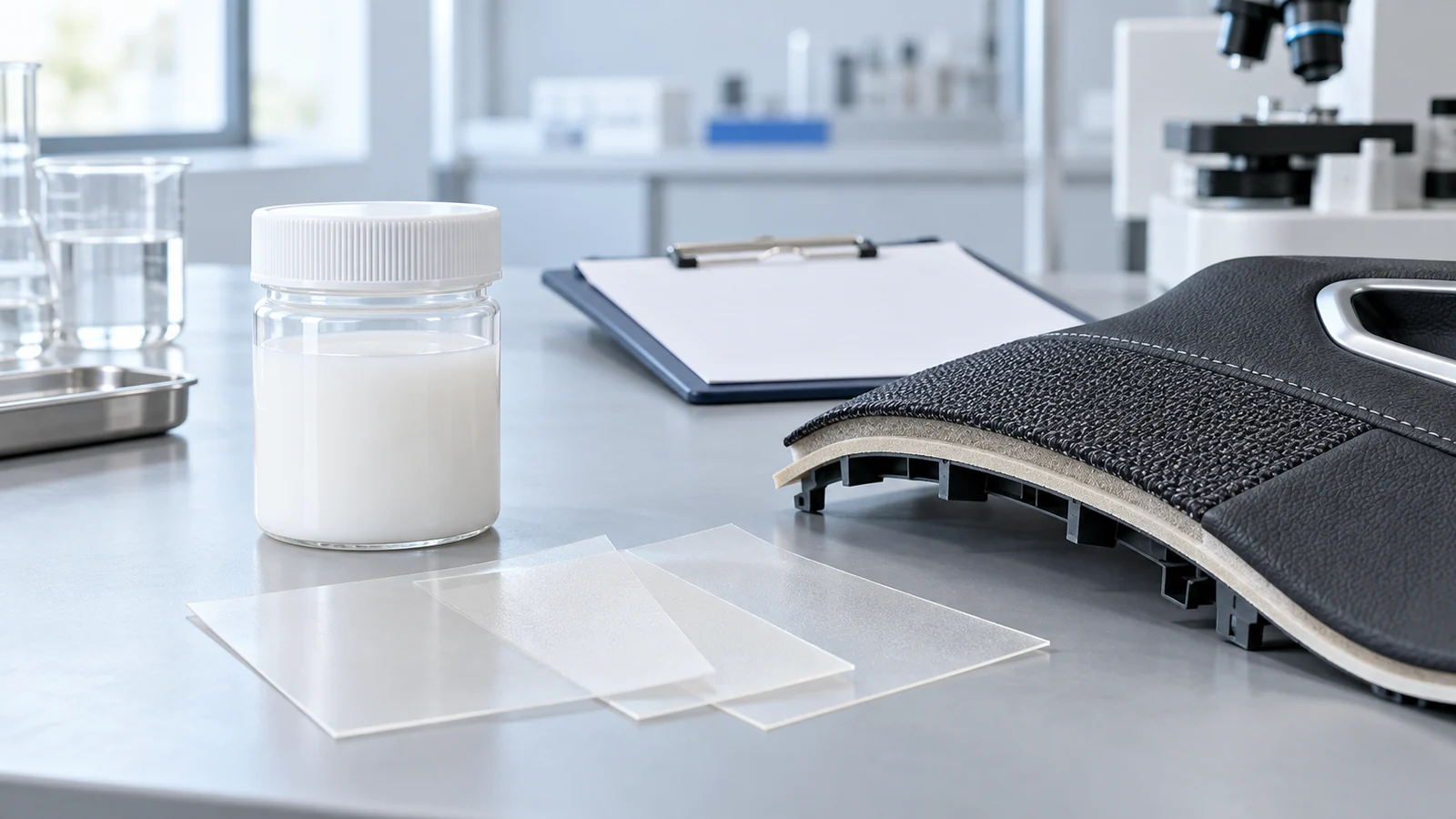
Purchasing needs to know whether a material can enter the next validation stage. Quality and engineering need to understand the conditions behind each conclusion. Start by separating the questions answered by the four report categories.
| Report category | Question addressed | Check first |
|---|---|---|
| Odor evaluation | Odor characteristics perceived under specified conditions | Method, temperature, time and scoring scale |
| VOC testing | Adhesive content or specimen emissions | Object, unit, sampling and analytical conditions |
| ELV-related testing | Specified restricted-substance testing or screening | Substances, method and assessment basis |
| REACH SVHC screening | Screening for substances on specified lists | Component identity, list date and reporting limits |
Read odor separately from VOC, and separate VOC content from emissions
Interpret odor scores under the stated conditions
The 2025 odor report for the R-5670 two-component water-based polyurethane adhesive references VES M00-08 [N], Method 2, and customer requirements. Specimen preparation was 20±2°C and 50±5% RH for 8 days. A 10 cm × 8 cm specimen was placed in a 10 L bag filled with 5 L nitrogen and evaluated at 90°C for 4 hours. Five assessors gave mean scores of 0.0 for irritation, 2.3 for odor intensity and −0.8 for pleasant/unpleasant odor. [4, pp. 2–3]
The 0.0 result applies only to the irritation score. Odor intensity and character were also recorded, so the report must not be summarized as odorless. Without an agreed project limit, do not assign a customer acceptance result. VDA's description also places odor assessment under temperature and climate conditions; this report uses VES, not VDA 270. [A]
2 g/L and ND answer different questions
The March 2026 report describes a white liquid named RELANET R-5670 water-based polyurethane emulsion. Referencing Annex D of GB 33372-2020, it gives VOC content of 2 g/L, a method detection limit (MDL) of 1 g/L and a stated limit of 50 g/L, with a conforming conclusion. [1, pp. 1–2]
That conclusion applies to the liquid specimen and the stated criteria. The report does not identify an addition of R-60C or a mixing ratio. Therefore, 2 g/L cannot automatically be used as the measured VOC content of every mixed formulation.
Two other R-5670 reports from 2025 assess emissions in µg/m³. They record specimen area and double-sided sampling, and the photographs show sheet-like specimens. Both record storage at 23±2°C and 50±10% RH for 1 day, but their analytical conditions differ. [2–3]
| Reference method | Analytical conditions | Reported TVOC result |
|---|---|---|
| VES M00-12 [N] | 60°C × 4 hours | TVOC (C6–C16): ND; MDL 10 µg/m³ |
| VES M00-03 [N] | 65°C × 2 hours | TVOC (C6–C16): ND; MDL 10 µg/m³ |
ND means below the method detection limit, not zero. The formaldehyde MDL in both reports is 12.5 µg/m³; it must not be replaced by the TVOC MDL of 10 µg/m³. g/L expresses adhesive content, while µg/m³ is the gas-concentration basis of these emission tests. They cannot be converted directly or used to rank two adhesives across different conditions. [2–3, pp. 2–3]
An earlier combined sample also underwent an emission test at 40°C for 2 hours. Its method, sample identity and storage history differ. Keep those results separate rather than combining them in a same-condition comparison chart. Odor must also be retained as a separate evaluation; it cannot be inferred from VOC results marked ND. [7; B]
For ELV and REACH, identify the sample before interpreting the conclusion
The earlier restricted-substance report names two products
ELV refers to the end-of-life-vehicle regulatory framework, which addresses restricted substances such as lead, cadmium, mercury and hexavalent chromium in vehicle materials. For a document described as an ELV report, check the actual scope and basis page by page. The early SGS document here lists GB/T 30512-2014 and M0303 [2018-N]; do not rename these as another test or a universal certification. [5; D]
Issued in January 2025, the report names the sample R-5210H & R-5670 two-component water-based polyurethane adhesive, describes the analyzed sample as transparent adhesive and records OK. It does not give independent conclusions for each model or establish correspondence with the current R-5670/R-60C system. [5, pp. 1–3]
The PBBs and PBDEs fields each show 54 ppm, but the notes state that these screening results represent total bromine. The XRF screening result in the Cr(VI) field represents total chromium. Underlining on the subsequent quantitative-analysis page means not tested. Do not describe 54 ppm as separate precise measurements of the two flame retardants or claim quantitative non-detection of all six items. [5, pp. 2–4]
Review the R-5670 and R-60C SVHC reports together
The two English reports issued on 16 September 2026 concern the R-5670 base and R-60C curing agent respectively, described as white liquid and blue liquid. These are separate component screenings, not a joint test of mixed adhesive, dry film or a finished interior part. [8–9, pp. 1, 4]
| Component | Scope stated in report | Summary conclusion |
|---|---|---|
| R-5670 base [8] | 253 Candidate List SVHCs as of 2026-02-04, plus 2 potential SVHCs | Each of the two scopes: ≤0.1% (w/w); both summaries marked Pass |
| R-60C curing agent [9] | Same listed scope; potential-SVHC status and date as specified in the report | Each of the two scopes: ≤0.1% (w/w); both summaries marked Pass |
The result pages state ND for the listed scope, meaning below the relevant reporting limit (RL). The RL and a regulatory threshold are different concepts; consult the appendices for individual limits. The 2 potential SVHCs must not be added to the 253 listed substances and described as a 255-substance official Candidate List. [8–9, pp. 1–5, 14]
These documents support the stated screening conclusions for the submitted samples and specified lists. They do not cover all REACH obligations or establish substance levels in a complete interior component or vehicle compliance. State the list cut-off date and compare it with project requirements and ECHA's list before submission. A newer report date does not guarantee coverage of every list update. [8–9, pp. 3–5; C]
How purchasing should interpret the fields in a real report
The following independently prepared reading table transcribes key fields from the R-5670 liquid-sample VOC report. It is an explanatory summary, not a reproduction of the SGS report or a replacement for the complete document. [1]
| Field | Reported value |
|---|---|
| Tested sample | R-5670 / A1 · White liquid · 200 mL |
| Reference method | GB 33372-2020 · Annex D |
| VOC | 2 g/L |
| MDL | 1 g/L |
| Stated limit | 50 g/L |
Sample identity comes before the measured value
Match R-5670 on page 1 with sample A1 on page 2. White liquid identifies the material analyzed; it is not a dried, cured and laminated interior part. The 200 mL product specification is neither coat weight nor adhesive-film thickness.
What do 50, 1 and 2 mean?
50 g/L is the report's stated limit, 1 g/L is the method detection limit and 2 g/L is the measured A1 result. A bounded citation is: the submitted R-5670 liquid sample had VOC content of 2 g/L by the stated method and met the report's stated 50 g/L limit.
This wording retains the result, specimen and basis. Changing it to zero VOC, non-toxic and odorless, or vehicle-cabin air-quality compliance would exceed the report's scope.
Use this checklist in purchasing and quality review
After reading the conclusion, complete the fields below. Ask the supplier for missing information. Retain differences until conditions are aligned rather than comparing the numbers immediately.
| Review field | Confirm | Reminder from these reports |
|---|---|---|
| Model and curing agent | Base, curing agent, mixing ratio, batch and current supplied version | Old combined names do not establish the current pairing; component tests are not mixed-adhesive tests |
| Sample state | Liquid, dry film, specimen, laminate or vehicle | Register liquid R-5670 and sheet-like specimens separately |
| Report and list dates | Issue date, revision, receipt date and list cut-off | Record report date and Candidate List date separately |
| Method and revision | Standard code, year, test option and customer additions | VES, NES and VDA methods are not interchangeable merely because names resemble each other |
| Preparation and conditioning | Ratio, coat weight or thickness, substrates, drying, conditioning, transport and storage | Full preparation formulation is not disclosed on the available sheet-specimen result pages |
| Conditions and units | Temperature, time, area, gas volume, sampling and result basis | Evaluate g/L content and µg/m³ emission results separately |
| Detection and reporting limits | MDL, RL, blanks, background and ND definition | Do not mix specimen MDLs with storage-environment background MDLs |
| Acceptance and scope | Source of limits, testing versus screening, customer acceptance of the version | Retain the specimen and scope behind conforming, OK or Pass |
Project or phase fields on a report cover are customer-supplied sample information. Alone, they do not establish OEM approval, production acceptance or approval of a material combination. Sample correspondence and project acceptance requirements determine whether a report is usable.
Liquid adhesive
Identify the base or mixed adhesive
VOC content may be expressed in g/L
Dry film or specimen
Record ratio, thickness and conditioning
Emission results depend on the test method
Interior laminate
Make specimens with the actual substrates and process
Evaluate the finished part against project requirements
Apply the reports to your own interior project
Applying adhesive to fabric, foam or plastic changes the evaluation object. Substrates, primer, surface treatment and the adhesive layer form a laminate; coat weight, drying and conditioning become part of its history. Even with the same adhesive model, line-made specimens need project-specific evaluation.
Fix the materials and process, then agree the submitted specimen form with the customer or laboratory. Record the base and curing-agent models, mass ratio, coat weight per unit area, drying conditions, pressing method and storage before testing. Explain any differences from the existing report and perform additional validation as agreed, rather than using the old report to replace a new specimen test.
Request the supplier document package clearly
| Document | Requested content |
|---|---|
| Complete report for the model | Full document and appendices, correct version and link to supplied product |
| Base and curing-agent TDS | Current issue, recommended ratio, application window, drying and conditioning |
| Base and curing-agent SDS | Separate documents matching supplied components and destination-market requirements |
| Component and change statement | Curing-agent identity, preparation record, relevant formulation and version/raw-material changes |
| Project sample-validation plan | Actual substrates and process, tests, conditions and acceptance limits |
If a report has no expiry date, can it always be used?
The issue date records a test at one point in time; it does not guarantee unchanged supply, formulation or customer requirements. Assess acceptance against the version, change history, list updates and the customer's report-age policy.
Does a lower odor score always mean a better project fit?
Check the method, temperature, time, scoring scale and sample history first. The earlier combined sample gave mean odor-intensity values of 1.4 and 1.8 under a different NES method. These cannot be ranked directly against 2.3 under the 2025 VES method. [4, 6]
What can an existing report support if the mixing ratio is missing?
It can support preliminary document review: identify the specimen, completed tests and questions to resolve. To apply a conclusion to the current mixed adhesive or finished part, establish sample correspondence and validate under the agreed process.
When requesting R-5670 and its paired curing-agent documents, provide the substrate combination, application process, odor and VOC requirements, restricted-substance list and test methods. This helps determine which reports apply and which conditions require validation before arranging samples.
Source documents and report references
The numbers below correspond to the in-text references. GZAT in each filename is an SGS job number; the report body also lists a CANAUTO report number. Do not confuse the two. Page numbers refer to the original PDFs.
| Reference | File and issue date | Pages and scope used |
|---|---|---|
| [1] | GZAT2603001821PC01_CN 2026-03-31 | pp. 1–2; liquid R-5670, VOC content and conforming conclusion · CANAUTO26006905501 |
| [2] | GZAT2509006029LW02_CN 2025-09-12 | pp. 1–5; R-5670 emissions at 60°C × 4 hours · CANAUTO25021950901 |
| [3] | GZAT2509006029LW03_CN 2025-09-11 | pp. 1–3; R-5670 emissions at 65°C × 2 hours · CANAUTO25021952101 |
| [4] | GZAT2509006029LW01_CN 2025-09-17 | pp. 1–3; R-5670 VES odor conditions and scores · CANAUTO25021949801 |
| [5] | GZAT2412006917OH01_CN 2025-01-07 | pp. 1–4; R-5210H & R-5670 restricted-substance screening and notes · CANAUTO24029780401 |
| [6] | GZAT2412006917OH02_CN 2025-01-08 | pp. 1–4; earlier combined-sample NES odor evaluation · CANAUTO24029718401 |
| [7] | GZAT2412006917OH03_CN 2025-01-15 | pp. 1–4; earlier combined-sample emissions at 40°C × 2 hours · CANAUTO24029719301 |
| [8] | GZAT2609006343PM01_EN 2026-09-16 | pp. 1–5, 6–14; R-5670 identity, SVHC results and lists · CANAUTO26026014001 |
| [9] | GZAT2609006343PM03_EN 2026-09-16 | pp. 1–5, 6–14; R-60C identity, SVHC results and lists · CANAUTO26026032601 |
Public method descriptions and regulatory background
[A] VDA 270: scope of odor-characteristic evaluation
[B] Fraunhofer WKI: separate odor and vehicle-material emission tests
[C] ECHA Candidate List: check before project submission
[D] EUR-Lex: Directive 2000/53/EC, consolidated version of 30 March 2023
[E] National standards information portal: GB 33372-2020
Source review: 2026-11-01. Public pages support method classification and background; paid standards were not reviewed clause by clause. SVHC counts follow the original reports and are not claimed to be the latest list at publication. The GB 33372-2020 information page was marked current at the manuscript's review. [E]